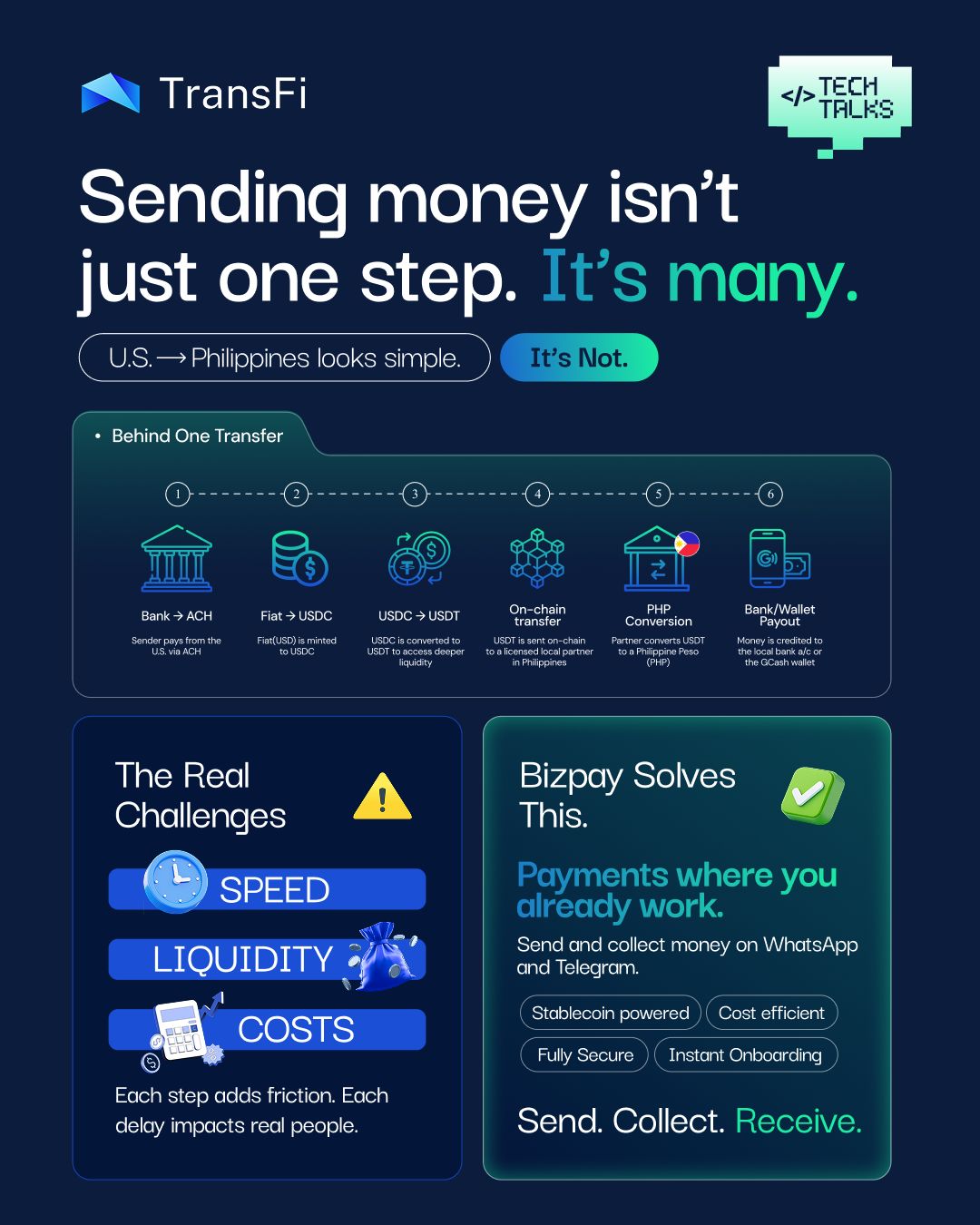

A “simple” cross-border payment isn’t simple.
Sending money from the U.S. to the Philippines involves multiple layers—banks, stablecoin conversions, on-chain transfers, liquidity providers, and local payout systems.
Each step introduces:
• Delays
• Costs
• Liquidity challenges
• Fragmentation
This is why traditional systems often charge 4–6% and still lack predictability.
The real innovation isn’t just stablecoins.
It’s stitching the entire flow together.
With BizPay, we integrate:
• Fiat rails
• Stablecoin infrastructure
• Local payout systems
Into one seamless, real-time experience.
One click. End-to-end.
That’s how global payments should work.
#TransFi #BizPay #Stablecoins #CrossBorderPayments #Fintech #GlobalPayments #EmergingMarkets
Sending money from the U.S. to the Philippines involves multiple layers—banks, stablecoin conversions, on-chain transfers, liquidity providers, and local payout systems.
Each step introduces:
• Delays
• Costs
• Liquidity challenges
• Fragmentation
This is why traditional systems often charge 4–6% and still lack predictability.
The real innovation isn’t just stablecoins.
It’s stitching the entire flow together.
With BizPay, we integrate:
• Fiat rails
• Stablecoin infrastructure
• Local payout systems
Into one seamless, real-time experience.
One click. End-to-end.
That’s how global payments should work.
#TransFi #BizPay #Stablecoins #CrossBorderPayments #Fintech #GlobalPayments #EmergingMarkets
Shared byAlex Noor - A month ago
Log in to comment
Loading ..
Related Articles
Join TransFi at Money20/20 Europe 2026: Simplifying Global Payments

Streamline Your Setup with BizPay: Say Goodbye to Waiting

TransFi at SiGMA World 2026: Engaging with Payment, Gaming, and Web3 Leaders

TransFi Team at Money20/20 Amsterdam: Cross-Border Payments & Compliance Insights

Rahul Sahni to Connect with Web3 Innovators at Crypto Valley Association 2026

TransFi at SiGMA World 2026: Leading Payments, Gaming, and Web3 Innovation
6
0/100