
Just one year ago, peaking gas was still doing much of the heavy lifting during Australia's evening peak. Today, that is no longer the case.
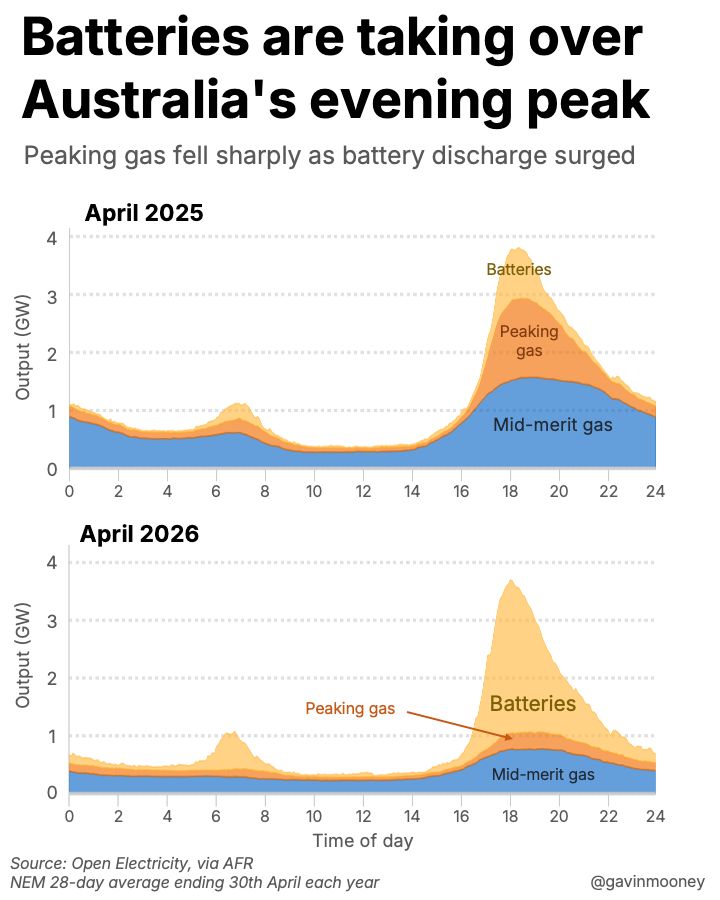
The chart below compares average daily dispatch profiles across Australia's main grid (the NEM) in April 2025 and April 2026.
The change in just one year is remarkable.
While peaking gas generation has fallen sharply, battery discharge has surged and is now dominating the evening peak.
This isn't just about more batteries being installed. It's also about batteries performing one of the grid's most valuable jobs: supplying electricity during the high-demand evening period when solar output falls away.
A few things stand out:
✅ Battery discharge in Q1 2026 was around 3x higher than a year earlier
✅ Batteries now set wholesale electricity prices roughly one-third of the time
✅ Wholesale electricity prices were 12% lower in Q1 - largely due to the influx of batteries
Perhaps most strikingly, battery discharge across the NEM has now overtaken peaking gas generation – and it appears on track to overtake mid-merit gas in the next year as well.
This shift is being primarily driven by economics.
Battery costs have fallen dramatically, projects have become larger and the growing spread between low daytime prices and higher evening prices increasingly favours battery storage.
For decades, peaking gas plants were the default solution for the evening peak.
Increasingly, that role is being performed by batteries instead.
#energy grid #battery discharge #peaking gas #renewable energy #electricity prices
The chart below compares average daily dispatch profiles across Australia's main grid (the NEM) in April 2025 and April 2026.
The change in just one year is remarkable.
While peaking gas generation has fallen sharply, battery discharge has surged and is now dominating the evening peak.
This isn't just about more batteries being installed. It's also about batteries performing one of the grid's most valuable jobs: supplying electricity during the high-demand evening period when solar output falls away.
A few things stand out:
✅ Battery discharge in Q1 2026 was around 3x higher than a year earlier
✅ Batteries now set wholesale electricity prices roughly one-third of the time
✅ Wholesale electricity prices were 12% lower in Q1 - largely due to the influx of batteries
Perhaps most strikingly, battery discharge across the NEM has now overtaken peaking gas generation – and it appears on track to overtake mid-merit gas in the next year as well.
This shift is being primarily driven by economics.
Battery costs have fallen dramatically, projects have become larger and the growing spread between low daytime prices and higher evening prices increasingly favours battery storage.
For decades, peaking gas plants were the default solution for the evening peak.
Increasingly, that role is being performed by batteries instead.
#energy grid #battery discharge #peaking gas #renewable energy #electricity prices
Shared byHayden Park - 14 hours ago
Log in to comment
Loading ..
Related Articles
Spain's Wholesale Electricity Prices Plummet as Renewables Dominate Generation

Understanding New Asset Class Structures in Litigation Finance
Maximize Solar Project Returns Through Engineering and Design Optimization

Understanding PIK Loans and the Challenges of Private Credit Valuations
Positive Pricing Update for European BESS Projects
3906
0/100