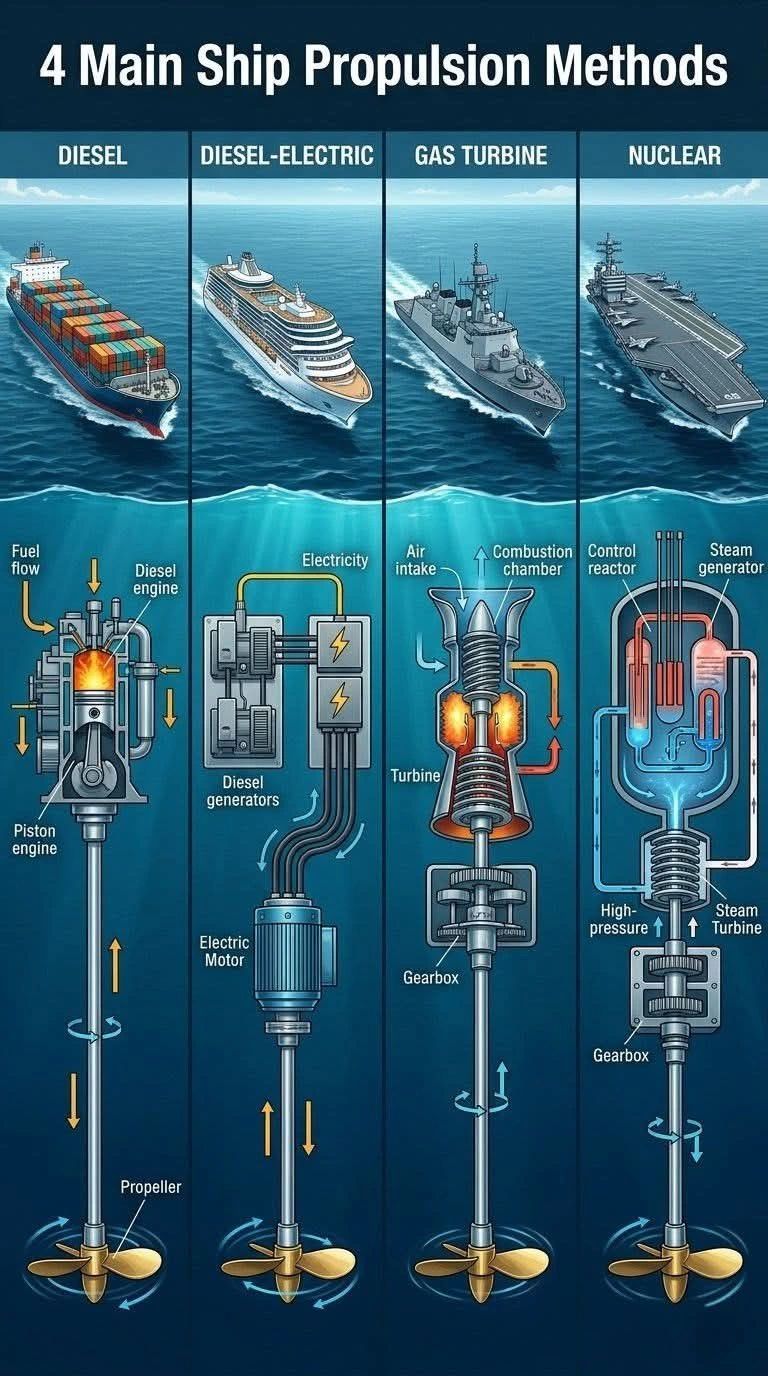

Moving massive vessels across the oceans is not just about power — it’s about how that power is generated, managed, and optimized.
Here are 4 main ship propulsion methods, with a closer technical look:
🔹 Diesel Propulsion
Still the backbone of global shipping.
Specific fuel consumption (SFOC): ~165–185 g/kWh for modern low-speed engines.
Direct drive = high efficiency (up to ~50%), but limited flexibility in load variation.
🔹 Diesel-Electric
Power is generated by diesel generators and distributed via electrical systems.
SFOC (gensets): ~175–210 g/kWh depending on load.
Key advantage: optimal load sharing, redundancy, and efficiency at partial loads — ideal for cruise ships and offshore vessels.
🔹 Gas Turbine
High power density and rapid start-up.
SFOC: ~250–300 g/kWh (less efficient than diesel).
Best suited where weight, space, and speed outweigh fuel economy — typical in naval applications.
🔹 Nuclear Propulsion
Virtually zero fuel consumption in operational terms.
Uses enriched uranium (typically 3–20% U-235 in naval reactors, depending on design).
Provides unmatched endurance — years without refueling — at the cost of complexity and strict safety requirements.
Each system reflects a different engineering priority:
efficiency, flexibility, performance, or endurance.
⚙️ In marine engineering, the real challenge is not choosing the most powerful system — but the most suitable one.
Credit:Vincenzo Greco
📌 Interested in learning more? Request your proposal here :
🌐 Visit our website: www.lloydmaritime.com
💡 Knowledge not shared is knowledge lost!
✅ Reshare to grow your network!
📩 Follow us,LLOYD'S MARITIME INSTITUTE (LMI
#MarineEngineering #ShipPropulsion #DieselEngine #DieselElectric #GasTurbine #NuclearPropulsion #EnergyEfficiency #NavalArchitecture #CruiseIndustry #Shipping #EngineeringExcellence #Maritime
Here are 4 main ship propulsion methods, with a closer technical look:
🔹 Diesel Propulsion
Still the backbone of global shipping.
Specific fuel consumption (SFOC): ~165–185 g/kWh for modern low-speed engines.
Direct drive = high efficiency (up to ~50%), but limited flexibility in load variation.
🔹 Diesel-Electric
Power is generated by diesel generators and distributed via electrical systems.
SFOC (gensets): ~175–210 g/kWh depending on load.
Key advantage: optimal load sharing, redundancy, and efficiency at partial loads — ideal for cruise ships and offshore vessels.
🔹 Gas Turbine
High power density and rapid start-up.
SFOC: ~250–300 g/kWh (less efficient than diesel).
Best suited where weight, space, and speed outweigh fuel economy — typical in naval applications.
🔹 Nuclear Propulsion
Virtually zero fuel consumption in operational terms.
Uses enriched uranium (typically 3–20% U-235 in naval reactors, depending on design).
Provides unmatched endurance — years without refueling — at the cost of complexity and strict safety requirements.
Each system reflects a different engineering priority:
efficiency, flexibility, performance, or endurance.
⚙️ In marine engineering, the real challenge is not choosing the most powerful system — but the most suitable one.
Credit:Vincenzo Greco
📌 Interested in learning more? Request your proposal here :
🌐 Visit our website: www.lloydmaritime.com
💡 Knowledge not shared is knowledge lost!
✅ Reshare to grow your network!
📩 Follow us,LLOYD'S MARITIME INSTITUTE (LMI
#MarineEngineering #ShipPropulsion #DieselEngine #DieselElectric #GasTurbine #NuclearPropulsion #EnergyEfficiency #NavalArchitecture #CruiseIndustry #Shipping #EngineeringExcellence #Maritime
Shared byHarper Noor - 9 days ago
Log in to comment
Loading ..
Related Articles

Railway Transport in Sandur's Mining Belt: Key to India's Mineral Exports

The Revolutionary Design of a Self-Sinking Ship for Deep-Sea Research

How Train Wheels Navigate Curves Without Steering: An Engineering Insight

India's Pioneering Hydrogen Train Nears Service Debut

Explore China's Dajue Mountain Cliff Train: A Unique Monorail Experience

Discover the Benefits of Tilting Diesel Trains on Curved Tracks
403
0/100