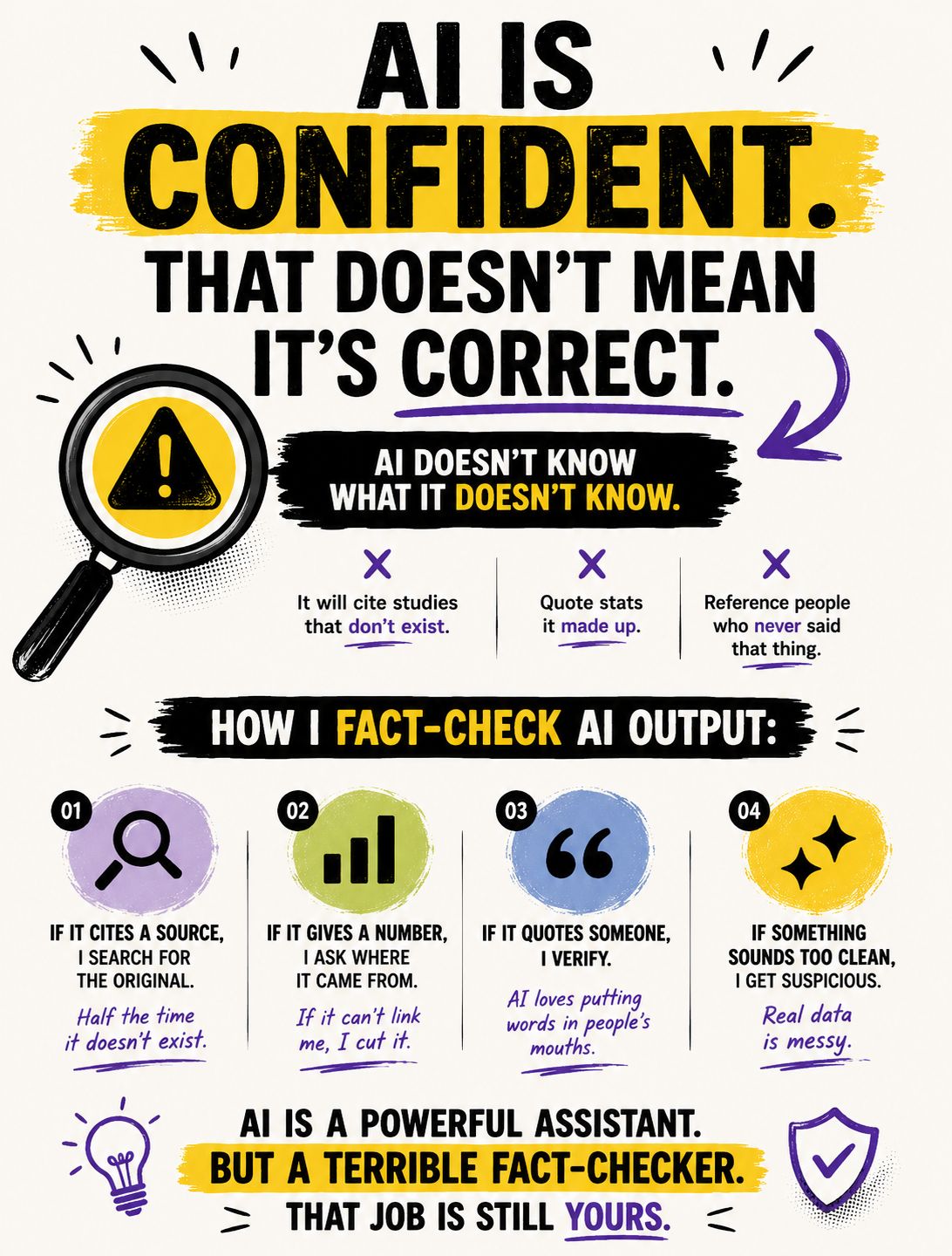

AI is confident. That doesn't mean it's correct.
Last month I almost published a stat it made up. Sounded right. Felt right. Wasn't real.
I use AI every day. For editing, for thinking, for pressure-testing ideas.
But I never let it be the final word on facts.
AI doesn't know what it doesn't know. It will cite a study that doesn't exist. Quote a stat it made up. Reference a person who never said that thing.
And it does all of this with the same tone it uses when it's right.
No hesitation, no uncertainty. Just confident wrongness.
That's dangerous if you're publishing content, sending emails, or making claims your audience will trust.
How I fact-check AI output:
→ If it cites a source, I search for the original. Half the time it doesn't exist.
→ If it gives a number, I ask where it came from. If it can't link me, I cut it.
→ If it quotes someone, I verify. AI loves putting words in people's mouths.
→ If something sounds too clean, I get suspicious. Real data is messy.
AI is a thinking partner, a research assistant, a draft machine.
But it's a terrible fact-checker.
That job is still yours.
The people building trust with their audience aren't the ones publishing fastest.
They're the ones who verify before they ship.
What's the closest call you've had with AI making something up?
♻️ Repost if this was useful.
🔔 Follow me for more on AI, marketing, and copywriting.
#AIfactchecking #contentverification #accuratereporting #AItrust #marketinginsights
Last month I almost published a stat it made up. Sounded right. Felt right. Wasn't real.
I use AI every day. For editing, for thinking, for pressure-testing ideas.
But I never let it be the final word on facts.
AI doesn't know what it doesn't know. It will cite a study that doesn't exist. Quote a stat it made up. Reference a person who never said that thing.
And it does all of this with the same tone it uses when it's right.
No hesitation, no uncertainty. Just confident wrongness.
That's dangerous if you're publishing content, sending emails, or making claims your audience will trust.
How I fact-check AI output:
→ If it cites a source, I search for the original. Half the time it doesn't exist.
→ If it gives a number, I ask where it came from. If it can't link me, I cut it.
→ If it quotes someone, I verify. AI loves putting words in people's mouths.
→ If something sounds too clean, I get suspicious. Real data is messy.
AI is a thinking partner, a research assistant, a draft machine.
But it's a terrible fact-checker.
That job is still yours.
The people building trust with their audience aren't the ones publishing fastest.
They're the ones who verify before they ship.
What's the closest call you've had with AI making something up?
♻️ Repost if this was useful.
🔔 Follow me for more on AI, marketing, and copywriting.
#AIfactchecking #contentverification #accuratereporting #AItrust #marketinginsights
Shared byElliot Noor - 5 days ago
Log in to comment
Loading ..
Related Articles
Navigating Toxic Workplaces: Strategies to Protect Yourself
Unlock Marketing Success: Insider Tips from a $200M+ Marketer

Utopai Studios Revolutionizes AI Content with Major Broadcasting Deals and Stellar Growth
Bad Copywriting VS Great Copywriting: Identifying the Differences
Protect Your Health to Enhance Career Longevity: The Hidden Truth Behind Success
Rapid Recovery Techniques: Bounce Back Fast in Minutes
145
0/100