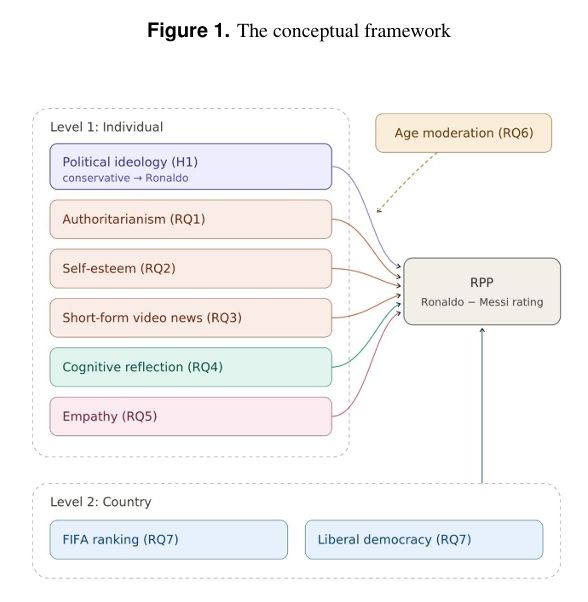

Political Identity Beyond Politics: The Messi–Ronaldo Preference Across 26 Countries by Saifuddin Ahmed, Kokil Jaidka, Muhammad Ehab Rasul, and Teresa Gil‐López.
Political identity increasingly shapes preferences far outside the realm of politics, yet most evidence for this comes from the United States. This paper asks whether the same pattern holds globally by turning to one of the world’s most stable cultural rivalries: Lionel Messi vs. Cristiano Ronaldo. Because the object of evaluation remains constant while the audience varies across 26 countries, the rivalry becomes a clean lens for examining how political identity travels into non‐political domains.
Using a survey of more than 10,600 respondents, the authors estimate multilevel models linking relative player preference to individual‐level ideology, authoritarianism, self‐esteem, short‐form video news use, and cognitive reflection, alongside country‐level factors such as FIFA ranking and liberal democracy scores. The results reveal a remarkably consistent pattern: political ideology is the strongest and most robust predictor of preference, even after accounting for demographics, media use, personality, and cognition. More liberal respondents tend to prefer Messi; more conservative respondents tend to prefer Ronaldo.
The study’s broader conclusion is that political identity reaches into cultural domains that appear, on the surface, to be apolitical. But this reach is not uniform; it is most pronounced among younger generations who have come of age during periods of heightened political sorting and identity‐driven polarization.
Read: http://spkl.io/604176tRd
#PoliticalIdentity #SocialPsychology #MediaEffects #Messi #Ronaldo #ComparativeResearch
Political identity increasingly shapes preferences far outside the realm of politics, yet most evidence for this comes from the United States. This paper asks whether the same pattern holds globally by turning to one of the world’s most stable cultural rivalries: Lionel Messi vs. Cristiano Ronaldo. Because the object of evaluation remains constant while the audience varies across 26 countries, the rivalry becomes a clean lens for examining how political identity travels into non‐political domains.
Using a survey of more than 10,600 respondents, the authors estimate multilevel models linking relative player preference to individual‐level ideology, authoritarianism, self‐esteem, short‐form video news use, and cognitive reflection, alongside country‐level factors such as FIFA ranking and liberal democracy scores. The results reveal a remarkably consistent pattern: political ideology is the strongest and most robust predictor of preference, even after accounting for demographics, media use, personality, and cognition. More liberal respondents tend to prefer Messi; more conservative respondents tend to prefer Ronaldo.
The study’s broader conclusion is that political identity reaches into cultural domains that appear, on the surface, to be apolitical. But this reach is not uniform; it is most pronounced among younger generations who have come of age during periods of heightened political sorting and identity‐driven polarization.
Read: http://spkl.io/604176tRd
#PoliticalIdentity #SocialPsychology #MediaEffects #Messi #Ronaldo #ComparativeResearch
Shared bySkyler Ray - 5 days ago
Log in to comment
Loading ..
Related Articles

Impact of For Women Scotland Supreme Court Ruling on Single-Sex Spaces

Delaware Corporate Law's Role in Geoengineering Regulation
Authoritarian Shift in International Economic Order: A New Global Landscape

Building Trustworthy AI: Human-Artificial Intelligence Interactions by Beth Coleman

Legal Analysis of Prosecutorial Contempt in U.S. Federal Courts
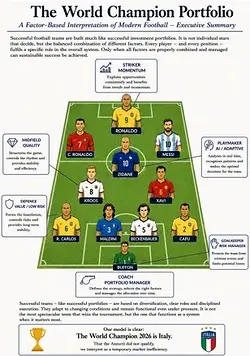
World Champion’s Portfolio: Factor-Based Football Analysis Ahead of 2026 FIFA World Cup
1
0/100