
After looking at multiple AI Agent projects, here's the most expensive mistake I keep seeing:
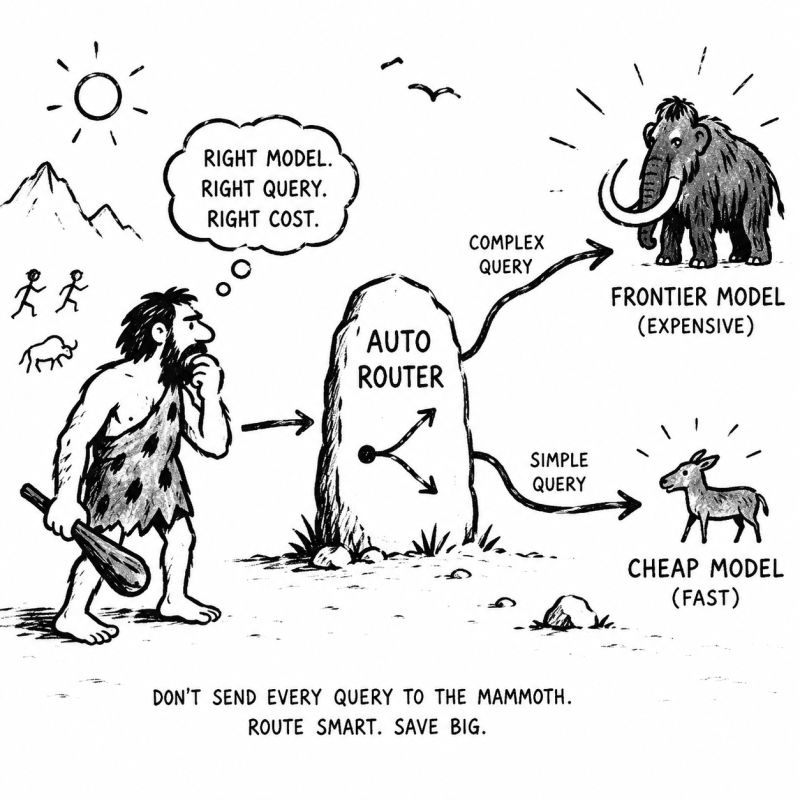
Every query in your agent goes to your most expensive model.
Simple greeting? Frontier model.
Basic classification? Frontier model.
One-line summarization? Frontier model.
"Just to be safe."
But "safe" is costing you 5-10x what it should.
I've watched companies burn thousands of euros every month on exactly this pattern.
Simple queries should go to cheap, fast models.
Complex queries go to your frontier model.
The hard part isn't deciding to do this. It's doing it without dropping quality.
So I tested Orq.ai's Auto Router on my own agent over a weekend, and evaluated whether it actually held up.
1️⃣ Built a Claude skill that spins up 10 simulated users across realistic scenarios.
2️⃣ Picked my model pair: Claude Sonnet as strong, Claude Haiku as economical. Same family, ~10x cost ratio. Set the router to Balanced mode. Orq lets you pick between Quality, Balanced, and Cost depending on how aggressive you want the savings.
3️⃣ Ran the same agent twice. Once entirely on Sonnet. Once through the Auto Router. Compared cost, latency, and quality using the evaluation and observability stack.
What I saw:
→ Cost came in close to ~45% reduction at Balanced
→ Quality stayed within ~2% of the Sonnet-only baseline
→ Fallback verified: when the cheap model returns low-confidence output, traffic escalates to Sonnet automatically
Most queries don't need frontier reasoning. The ones that do, still get it.
Remember: LLM is an infrastructure problem.
Routing is one of the layers nobody talks about, until the bill arrives.
What does your routing strategy look like today?
P.S. You should also check full breakdown of the AutoRouter design and validation:
Would definitely recommend based on my own experience.
#AI cost optimization #Auto routing #LLM efficiency #AI model management #Tech savings
Every query in your agent goes to your most expensive model.
Simple greeting? Frontier model.
Basic classification? Frontier model.
One-line summarization? Frontier model.
"Just to be safe."
But "safe" is costing you 5-10x what it should.
I've watched companies burn thousands of euros every month on exactly this pattern.
Simple queries should go to cheap, fast models.
Complex queries go to your frontier model.
The hard part isn't deciding to do this. It's doing it without dropping quality.
So I tested Orq.ai's Auto Router on my own agent over a weekend, and evaluated whether it actually held up.
1️⃣ Built a Claude skill that spins up 10 simulated users across realistic scenarios.
2️⃣ Picked my model pair: Claude Sonnet as strong, Claude Haiku as economical. Same family, ~10x cost ratio. Set the router to Balanced mode. Orq lets you pick between Quality, Balanced, and Cost depending on how aggressive you want the savings.
3️⃣ Ran the same agent twice. Once entirely on Sonnet. Once through the Auto Router. Compared cost, latency, and quality using the evaluation and observability stack.
What I saw:
→ Cost came in close to ~45% reduction at Balanced
→ Quality stayed within ~2% of the Sonnet-only baseline
→ Fallback verified: when the cheap model returns low-confidence output, traffic escalates to Sonnet automatically
Most queries don't need frontier reasoning. The ones that do, still get it.
Remember: LLM is an infrastructure problem.
Routing is one of the layers nobody talks about, until the bill arrives.
What does your routing strategy look like today?
P.S. You should also check full breakdown of the AutoRouter design and validation:
Would definitely recommend based on my own experience.
#AI cost optimization #Auto routing #LLM efficiency #AI model management #Tech savings
Shared byEmerson Nguyen - 14 hours ago
Log in to comment
Loading ..
Related Articles

Top 6 Must-Read Books for Beginners in AI and ML
Beyond LLMs: The Comprehensive World of AI Agent Engineering

Exciting AI Meetup at Berlin Applied AI Conf: A Glimpse into Future Innovations
7 Essential System Design Patterns for AI Engineers in Interviews

Understanding Key AI Engineering Terms: Authentication, Authorization, and More
Cracking AI/ML Interviews: Essential Skills and Resources You Need
242
0/100