
Not all failures begin with obvious wear.
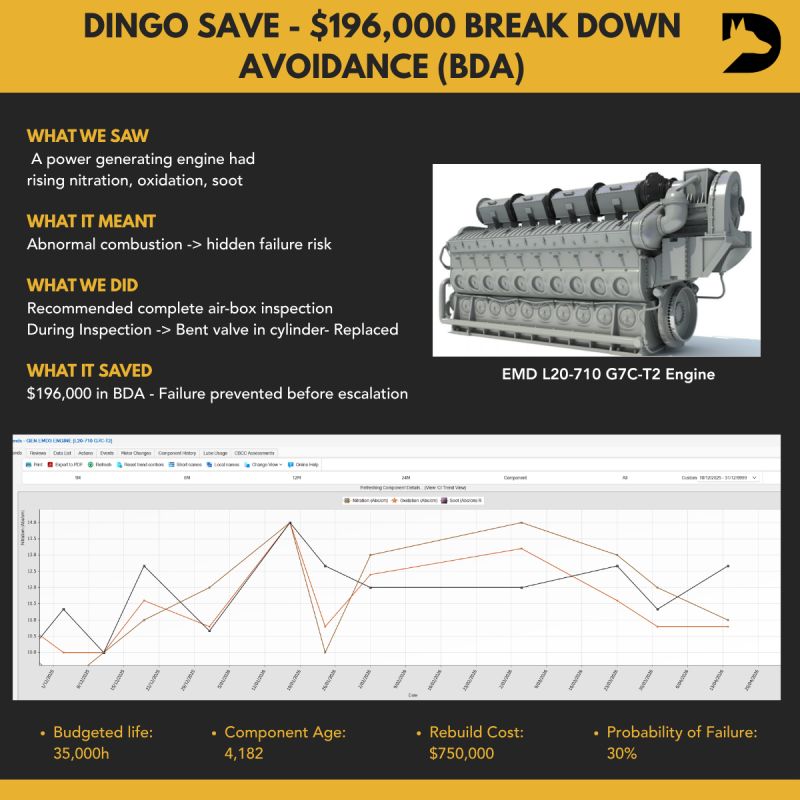
In a recent case, one of four engines powering a remote mine site began showing a steady increase in nitration, oxidation, and soot levels, despite no abnormal wear metals being detected.
The lab results were classified as normal. However, the operating context told a different story.
These engines had been closely monitored since commissioning, and the pattern did not align with expected operating conditions. The combination of signals pointed to abnormal combustion and a developing failure mechanism already in motion.
The alert was escalated to critical, and a full air-box inspection was recommended immediately.
The inspection identified a bent valve in one of the cylinders.
The repair itself was relatively straightforward:
- Cylinder head replacement
- Compression checks completed
- Engine returned to service
What was avoided was far more significant: a catastrophic engine failure that would have taken a critical power unit offline and disrupted site operations.
Estimated breakdown avoidance: $196,000.
Most operations already have large volumes of condition monitoring data. The challenge is identifying when a “normal” result does not reflect operational reality, especially when the early indicators are subtle and distributed across multiple data sources.
That’s where operational context, reliability expertise, and the ability to connect signals early become critical.
If improving how your team identifies and acts on emerging failures is a priority, we’d be glad to talk.
#PredictiveMaintenance #HeavyEquipment
In a recent case, one of four engines powering a remote mine site began showing a steady increase in nitration, oxidation, and soot levels, despite no abnormal wear metals being detected.
The lab results were classified as normal. However, the operating context told a different story.
These engines had been closely monitored since commissioning, and the pattern did not align with expected operating conditions. The combination of signals pointed to abnormal combustion and a developing failure mechanism already in motion.
The alert was escalated to critical, and a full air-box inspection was recommended immediately.
The inspection identified a bent valve in one of the cylinders.
The repair itself was relatively straightforward:
- Cylinder head replacement
- Compression checks completed
- Engine returned to service
What was avoided was far more significant: a catastrophic engine failure that would have taken a critical power unit offline and disrupted site operations.
Estimated breakdown avoidance: $196,000.
Most operations already have large volumes of condition monitoring data. The challenge is identifying when a “normal” result does not reflect operational reality, especially when the early indicators are subtle and distributed across multiple data sources.
That’s where operational context, reliability expertise, and the ability to connect signals early become critical.
If improving how your team identifies and acts on emerging failures is a priority, we’d be glad to talk.
#PredictiveMaintenance #HeavyEquipment
Shared byRowan Reid - 14 days ago
Log in to comment
Loading ..
Related Articles

Streamline Fleet Data Reconciliation with Dingo's Unified Asset Intelligence
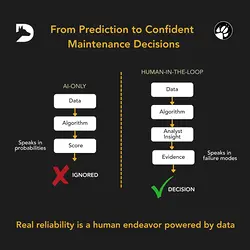
Overcoming the Credibility Gap in Mining with Expert Decision Certainty

Revolutionizing Mining Maintenance: AI and Proactive Strategies

Closing the Gap: Actionable Insights Beyond Alarms at CIM CONNECT + Expo

Maximize Asset Efficiency: CIM CONNECT's Data-Driven Solutions for Industry Leaders

Komatsu 830E Trouble Avoidance: Data-Driven Insights Save $203K
11
0/100