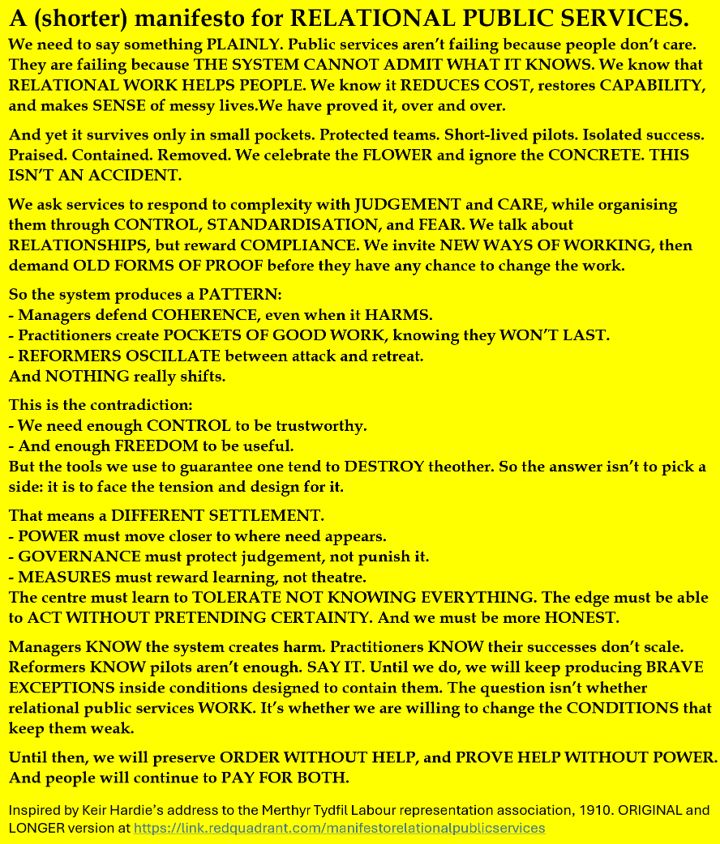

A (shorter) manifesto for relational public services.
We need to say something plainly. Public services aren’t failing because people don’t care.
They are failing because the system cannot admit what it knows.
We know that relational work helps people.
We know it reduces cost, restores capability, and makes sense of messy lives.
We have proved it, over and over.
And yet it survives only in small pockets. Protected teams. Short-lived pilots. Isolated success. Praised. Contained. Removed.
We celebrate the flower and ignore the concrete.
This isn’t an accident.
We ask services to respond to complexity with judgement andcare,
while organising them through control, standardisation, and fear.
We talk about relationships, but reward compliance.
We invite new ways of working, then demand old forms of proof before they have any chance to change the work.
So the system produces a pattern:
- Managers defend coherence, even when it harms.
- Practitioners create pockets of good work, knowing they won’t last.
- Reformers oscillate between attack and retreat.
And nothing really shifts.
This is the contradiction:
- We need enough control to be trustworthy.
- And enough freedom to be useful.
But the tools we use to guarantee one tend to destroy theother. So the answer isn’t to pick a side: it is to face the tension and design for it.
That means a different settlement.
- Power must move closer to where need appears.
- Governance must protect judgement, not punish it.
- Measures must reward learning, not theatre.
The centre must learn to tolerate not knowing everything.
The edge must be able to act without pretending certainty.
And we must be more honest.
Managers know the system creates harm. Practitioners know their successes don’t scale. Reformers know pilots aren’t enough. Say it.
Until we do, we will keep producing brave exceptions inside conditions designed to contain them.
The question isn’t whether relational public services work. It’s whether we are willing to change the conditions that keep them weak.
Until then, we will preserve order without help, and prove help without power.
And people will continue to pay for both.
#publicservices #systemicchange #relationalwork #publicservicereform #governancereform
We need to say something plainly. Public services aren’t failing because people don’t care.
They are failing because the system cannot admit what it knows.
We know that relational work helps people.
We know it reduces cost, restores capability, and makes sense of messy lives.
We have proved it, over and over.
And yet it survives only in small pockets. Protected teams. Short-lived pilots. Isolated success. Praised. Contained. Removed.
We celebrate the flower and ignore the concrete.
This isn’t an accident.
We ask services to respond to complexity with judgement andcare,
while organising them through control, standardisation, and fear.
We talk about relationships, but reward compliance.
We invite new ways of working, then demand old forms of proof before they have any chance to change the work.
So the system produces a pattern:
- Managers defend coherence, even when it harms.
- Practitioners create pockets of good work, knowing they won’t last.
- Reformers oscillate between attack and retreat.
And nothing really shifts.
This is the contradiction:
- We need enough control to be trustworthy.
- And enough freedom to be useful.
But the tools we use to guarantee one tend to destroy theother. So the answer isn’t to pick a side: it is to face the tension and design for it.
That means a different settlement.
- Power must move closer to where need appears.
- Governance must protect judgement, not punish it.
- Measures must reward learning, not theatre.
The centre must learn to tolerate not knowing everything.
The edge must be able to act without pretending certainty.
And we must be more honest.
Managers know the system creates harm. Practitioners know their successes don’t scale. Reformers know pilots aren’t enough. Say it.
Until we do, we will keep producing brave exceptions inside conditions designed to contain them.
The question isn’t whether relational public services work. It’s whether we are willing to change the conditions that keep them weak.
Until then, we will preserve order without help, and prove help without power.
And people will continue to pay for both.
#publicservices #systemicchange #relationalwork #publicservicereform #governancereform
Shared byKai Gray - 14 days ago
Log in to comment
Loading ..
Related Articles
Consulting Industry's Dependency vs Transformation: A Candid Discussion
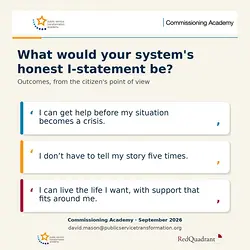
Focusing on Citizen Outcomes: Transforming Public Service Systems
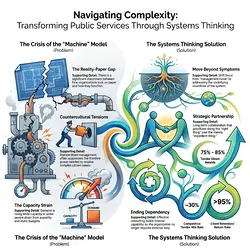
Bridging the Gap: Transforming Paper Plans into Reality
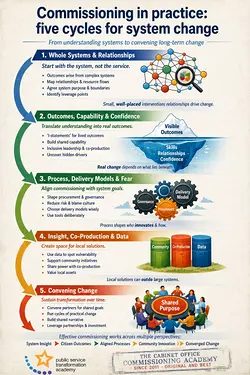
Revolutionize Public Service Commissioning: Systems Thinking and Beyond
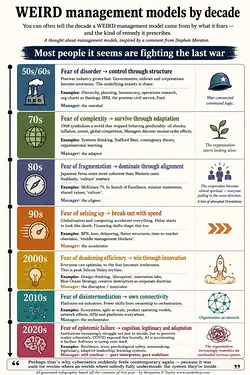
Decoding Decades: Management Models Through Their Fears and Remedies

How 'Island of the Blue Dolphins' Shaped My Understanding of Resilience and Agency
34
0/100