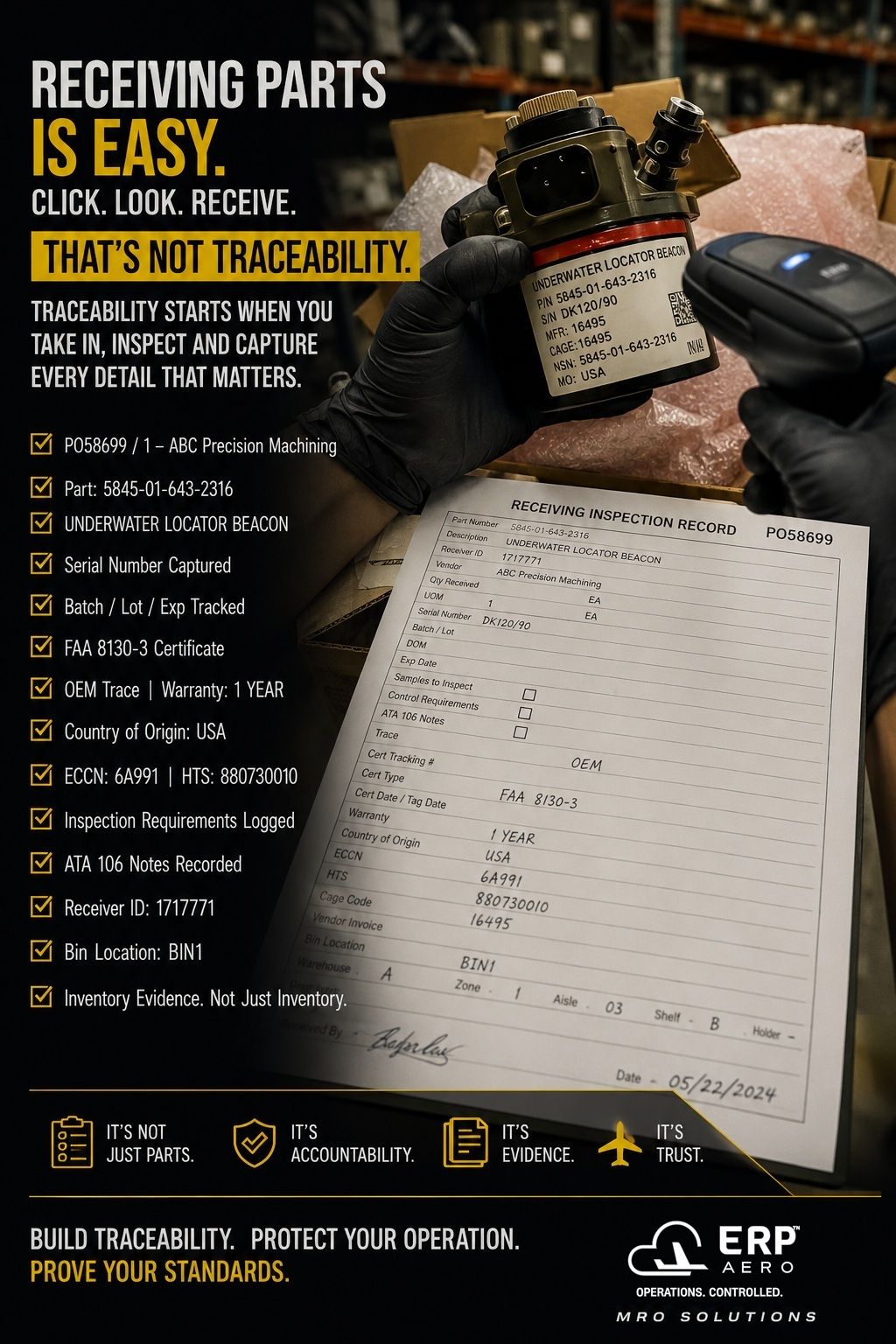

People love to say:
"Receiving inventory is easy. Just click Receive."
No.
Receiving inventory? It's is the easy part.
Traceability starts after the click.
It starts when the system forces you to answer the questions that actually matter:
• What serial number was received?
• What batch or lot was it tied to?
• What trace came with it?
• Which PO funded it?
• Which vendor supplied it?
• Which certificate was attached?
• What warranty exists?
• What country of origin was declared?
• What ECCN and HTS classifications apply?
• What bin was it placed into?
• What inspection requirements exist?
• What calibration, shelf life, or control requirements apply?
• What ATA 106 notes were captured?
• What receiver touched it?
• What warehouse location holds it today?
• and so much more!
That's not "receiving."
That's real accountability - which is so much more than a checkmark.
A screen that says "Received Qty: 1" doesn't tell you much.
A traceable system tells you:
PO58699.
Receiver 1717771.
Serial tracked.
FAA 8130 attached.
OEM trace captured.
Warranty recorded.
Country of origin documented.
ECCN classified.
Bin assigned.
Inspection requirements logged.
One barely creates inventory.
The other creates evidence.
And when an auditor, customer, regulator, quality manager, or executive asks where that part came from, who touched it, what documents support it, and where it is now...
...you find out very quickly whether your system stores parts or stores truth.
Big difference.
More than ERP, ERP.Aero!
#inventorymanagement #traceability #supplychain #accountability #erpsystems
"Receiving inventory is easy. Just click Receive."
No.
Receiving inventory? It's is the easy part.
Traceability starts after the click.
It starts when the system forces you to answer the questions that actually matter:
• What serial number was received?
• What batch or lot was it tied to?
• What trace came with it?
• Which PO funded it?
• Which vendor supplied it?
• Which certificate was attached?
• What warranty exists?
• What country of origin was declared?
• What ECCN and HTS classifications apply?
• What bin was it placed into?
• What inspection requirements exist?
• What calibration, shelf life, or control requirements apply?
• What ATA 106 notes were captured?
• What receiver touched it?
• What warehouse location holds it today?
• and so much more!
That's not "receiving."
That's real accountability - which is so much more than a checkmark.
A screen that says "Received Qty: 1" doesn't tell you much.
A traceable system tells you:
PO58699.
Receiver 1717771.
Serial tracked.
FAA 8130 attached.
OEM trace captured.
Warranty recorded.
Country of origin documented.
ECCN classified.
Bin assigned.
Inspection requirements logged.
One barely creates inventory.
The other creates evidence.
And when an auditor, customer, regulator, quality manager, or executive asks where that part came from, who touched it, what documents support it, and where it is now...
...you find out very quickly whether your system stores parts or stores truth.
Big difference.
More than ERP, ERP.Aero!
#inventorymanagement #traceability #supplychain #accountability #erpsystems
Shared byKendall Reid - 4 days ago
Log in to comment
Loading ..
Related Articles
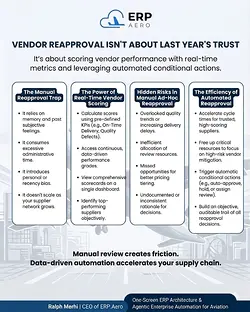
Transform Vendor Management with Data-Driven Automation and Real-Time Performance Metrics

Revolutionize RFQ Management with ERP.Aero's Integrated Solution
Transforming Aviation Operations: The Power of Standardized Workflows

Fix Your ERP: Seamless RFQ Management with ERP.Aero
Integrate Certifications into Operational Workflow for True Aviation Compliance
Streamline Aviation Inventory with ERP.Aero's Real-Time Sync
3
0/100