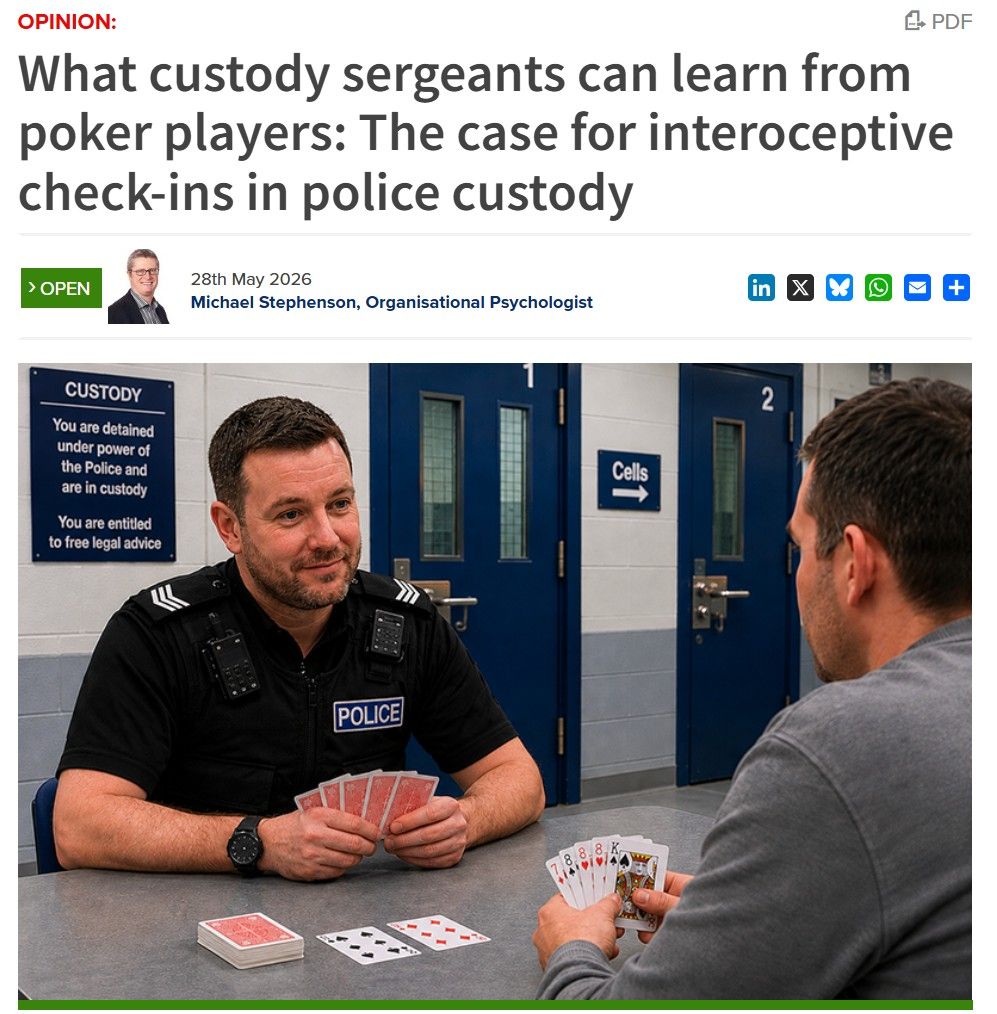

Implicit bias training has become the default policy response to disproportionate use of force, but evidence suggests it changes knowledge, not behaviour; organisational psychologist Michael Stephenson looks to an unexpected source – the world of professional poker – for a more effective approach, grounded in neuroscience rather than sociology.
❝The tilted player is not choosing badly. They are, briefly, a different kind of decision-maker. What elite players discovered is that the body signals this state before the conscious mind catches up.❞
❝When a warrior-oriented officer enters a custody block expecting threat, their body begins generating physiological preparation – elevated heart rate, heightened sympathetic arousal – before any evidence of actual danger.❞
❝Research on the psychophysiology of police decision-making has established something that should disturb every custody trainer: physiological arousal under threat degrades verbal communication skills while leaving tactical and physical skills largely intact.❞
❝Knowing that tilt impairs decision-making does not prevent tilt. The knowledge is completely useless unless the player has also developed the interoceptive capacity to notice when it is arriving.❞
❝The implication for custody training is direct: interoceptive awareness is the floor, not the ceiling. It is what survives when everything else is under pressure, which is precisely when it is most needed.❞
❝The warrior capacity is genuinely necessary for a small subset of policing encounters. The problem is cultural generalisation – the enculturation of threat-readiness into every context, including those that structurally demand its opposite. Custody is the most concentrated example of this problem in British policing.❞
❝The custody sergeant, already the most important cultural actor in the suite, can model this behaviour with measurable downstream effects on their team’s collective arousal baseline.❞
❝Rather than asking warrior-oriented officers to abandon an identity, interoceptive training asks them to add a skill: the ability to accurately read their own operational state and calibrate their response accordingly.❞
#policetraining #neuroscience #implicitbias #decisionmaking #interoceptiveawareness
❝The tilted player is not choosing badly. They are, briefly, a different kind of decision-maker. What elite players discovered is that the body signals this state before the conscious mind catches up.❞
❝When a warrior-oriented officer enters a custody block expecting threat, their body begins generating physiological preparation – elevated heart rate, heightened sympathetic arousal – before any evidence of actual danger.❞
❝Research on the psychophysiology of police decision-making has established something that should disturb every custody trainer: physiological arousal under threat degrades verbal communication skills while leaving tactical and physical skills largely intact.❞
❝Knowing that tilt impairs decision-making does not prevent tilt. The knowledge is completely useless unless the player has also developed the interoceptive capacity to notice when it is arriving.❞
❝The implication for custody training is direct: interoceptive awareness is the floor, not the ceiling. It is what survives when everything else is under pressure, which is precisely when it is most needed.❞
❝The warrior capacity is genuinely necessary for a small subset of policing encounters. The problem is cultural generalisation – the enculturation of threat-readiness into every context, including those that structurally demand its opposite. Custody is the most concentrated example of this problem in British policing.❞
❝The custody sergeant, already the most important cultural actor in the suite, can model this behaviour with measurable downstream effects on their team’s collective arousal baseline.❞
❝Rather than asking warrior-oriented officers to abandon an identity, interoceptive training asks them to add a skill: the ability to accurately read their own operational state and calibrate their response accordingly.❞
#policetraining #neuroscience #implicitbias #decisionmaking #interoceptiveawareness
Shared byTaylor Bose - 5 days ago
Log in to comment
Loading ..
Related Articles
Essential Autism Awareness Training for Police: Enhancing Community Trust
NCA's IT Systems Fail Inspection: Need for Long-Term Strategy and Cultural Change
Integrating Technology for a Unified Justice System
Building Procedural Justice in Australian Street-Level Drug Law Enforcement
West Yorkshire's Multi-Agency Women’s Safety Unit Cuts Rape Investigation Times by 40%
Addressing Sexual and Violent Offender Management to Safeguard Public Wellbeing
12
0/100