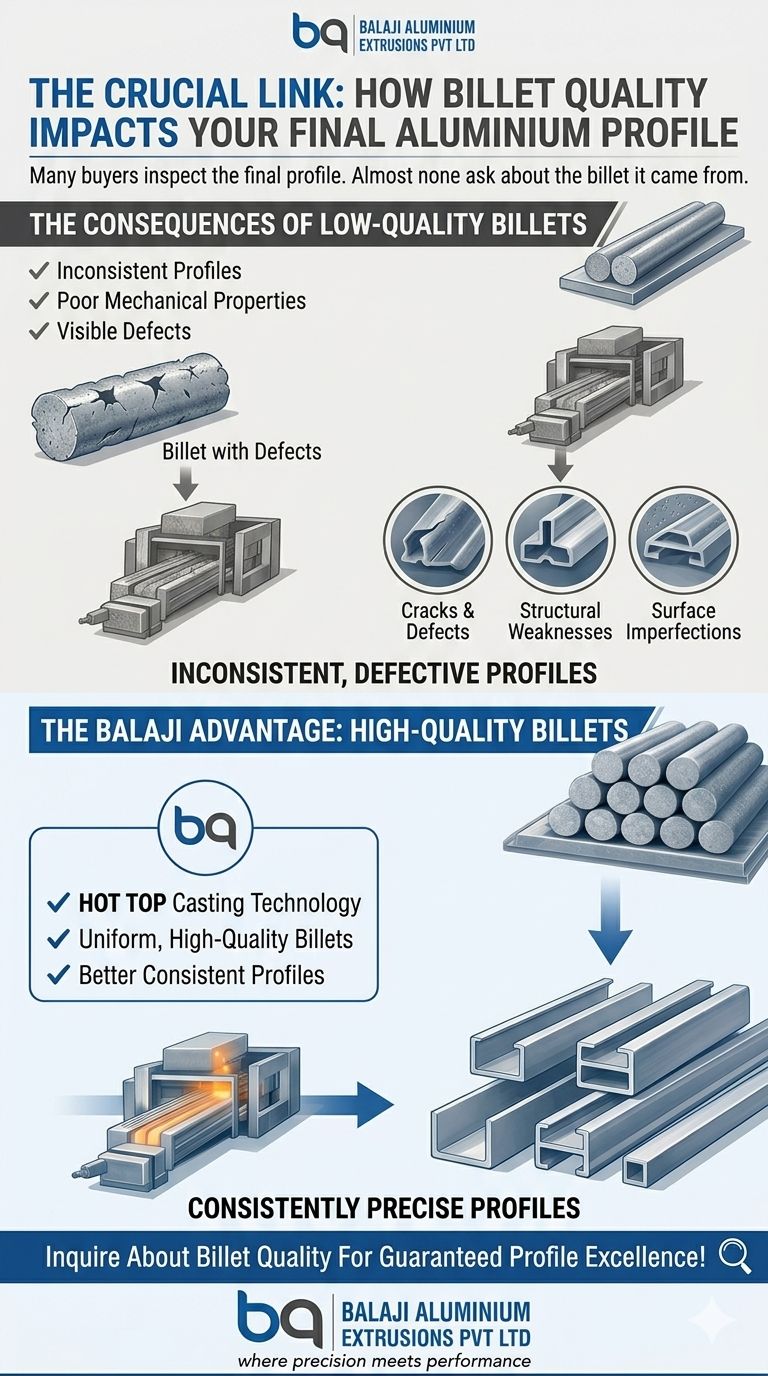

Most aluminium buyers inspect the final profile. Almost none ask about the billet it came from.
That one blind spot is the reason so many manufacturers end up with cracked profiles, structural weaknesses, and surface defects that fail quality checks mid-project.
Here is what actually happens when you use low-quality billets in the extrusion process. The raw billet enters the press already carrying internal porosity, impurities, or inconsistent grain structure. No matter how good your extrusion equipment is, a defective billet produces a defective profile. You cannot press quality into metal that does not have it to begin with.
The three most common problems that trace back to billet quality are cracks and surface defects that appear after extrusion, structural weaknesses that reduce load-bearing capacity, and profile inconsistencies that make fabrication and assembly harder than it needs to be.
At Balaji Aluminium Extrusions, we use HOT TOP casting technology to produce billets that are uniform in density, clean in composition, and consistent from one cast to the next. When the billet going into the press is right, the profile coming out of it is right too.
If you are sourcing aluminium extrusions for construction, industrial, or commercial applications, billet quality should be the first question you ask your supplier, not an afterthought.
Drop a comment or send a message if you want to know more about how billet quality directly affects your profile specifications.
#AluminiumExtrusions #AluminiumProfiles #BilletQuality #AluminiumManufacturing #ExtrusionProcess #MetalFabrication #AluminiumIndustry #IndustrialManufacturing #StructuralAluminium #ManufacturingQuality #BalajiAluminium
That one blind spot is the reason so many manufacturers end up with cracked profiles, structural weaknesses, and surface defects that fail quality checks mid-project.
Here is what actually happens when you use low-quality billets in the extrusion process. The raw billet enters the press already carrying internal porosity, impurities, or inconsistent grain structure. No matter how good your extrusion equipment is, a defective billet produces a defective profile. You cannot press quality into metal that does not have it to begin with.
The three most common problems that trace back to billet quality are cracks and surface defects that appear after extrusion, structural weaknesses that reduce load-bearing capacity, and profile inconsistencies that make fabrication and assembly harder than it needs to be.
At Balaji Aluminium Extrusions, we use HOT TOP casting technology to produce billets that are uniform in density, clean in composition, and consistent from one cast to the next. When the billet going into the press is right, the profile coming out of it is right too.
If you are sourcing aluminium extrusions for construction, industrial, or commercial applications, billet quality should be the first question you ask your supplier, not an afterthought.
Drop a comment or send a message if you want to know more about how billet quality directly affects your profile specifications.
#AluminiumExtrusions #AluminiumProfiles #BilletQuality #AluminiumManufacturing #ExtrusionProcess #MetalFabrication #AluminiumIndustry #IndustrialManufacturing #StructuralAluminium #ManufacturingQuality #BalajiAluminium
Shared byMorgan Yoon - A month ago
Log in to comment
Loading ..
Related Articles

Join Balaji Aluminium: Hiring Experienced NPD Manager for Dynamic Team

Thermal Management in LED Lighting: Why Aluminium Profiles Matter
The Costly Oversight of Supplier Material Traceability in Defence and Aerospace

Join Balaji Aluminium as an NPD Manager: Apply Now for New Product Development Role

Join Our Team: Exciting NPD Manager Opportunity at Balaji Aluminium

Advanced Aluminium Extrusion Design and Engineering Excellence
7
0/100