
Most companies have a strategy.
But only 10% execute it well:
Why do some organizations achieve their goals
While others struggle to make progress?
One framework that helps answer this question is:
The Strategy Pyramid.
Originally introduced by Wendy McGuinness (2011),
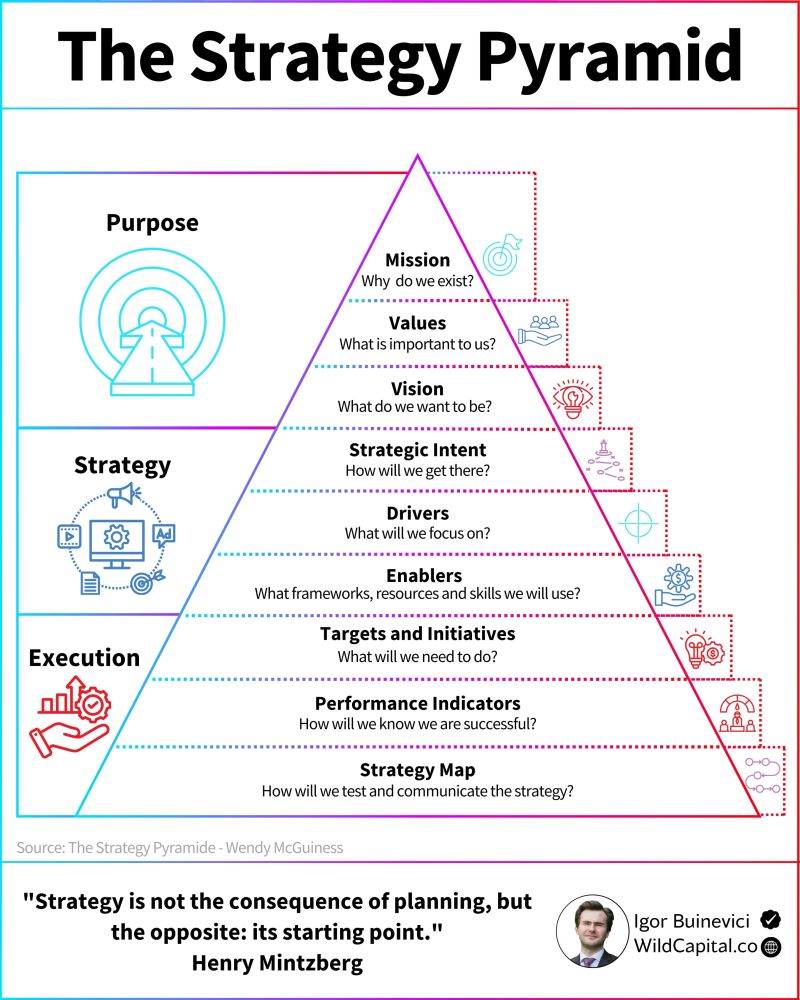
It breaks strategy into 9 key components grouped into 3 areas:
Purpose, Strategy, and Execution.
A) Purpose
1. Mission
Defines why the organization exists and the value it aims to create.
It answers the question: "Why are we here?"
2. Values
The principles and standards that guide decisions.
Behaviors, and company culture across the organization.
3. Vision
A clear description of the future state the organization wants to achieve.
The direction it is working toward.
B) Strategy
4. Strategic Intent
Establishes the long-term objectives and ambitions.
Outlines what success looks like.
5. Drivers
The critical priorities that fuel growth and competitive advantage.
Such as innovation, customer experience, operational excellence, or market expansion.
6. Enablers
The capabilities, resources, systems, technology, talent, and funding required to turn strategy into reality.
C) Execution
7. Targets and Initiatives
Specific goals and projects that translate strategy into action and provide a roadmap for implementation.
8. Performance Indicators
Metrics and KPIs that measure progress, identify gaps, and ensure accountability across teams.
9. Strategy Map
A visual representation of the strategy that aligns employees around priorities and shows how different objectives connect.
Together, these elements help leaders:
A) Build a coherent strategy,
B)Define the organization's purpose,
C) Execute it successfully across the business.
Many companies focus heavily on strategy creation.
Others focus only on execution.
The best organizations excel at both.
Every layer of the pyramid matters.
Ignoring one often weakens the entire structure.
P.S. Which part do you neglect most often?
♻️ Repost this to help more leaders improve strategy execution.
----
📌 Get my top 100 infographics for free:
1) Follow me.
2) Subscribe to my free newsletter at WildCapital.co.
You’ll receive them directly in your welcome email.
#strategy execution #business strategy #organizational success #strategic planning #leadership development
But only 10% execute it well:
Why do some organizations achieve their goals
While others struggle to make progress?
One framework that helps answer this question is:
The Strategy Pyramid.
Originally introduced by Wendy McGuinness (2011),
It breaks strategy into 9 key components grouped into 3 areas:
Purpose, Strategy, and Execution.
A) Purpose
1. Mission
Defines why the organization exists and the value it aims to create.
It answers the question: "Why are we here?"
2. Values
The principles and standards that guide decisions.
Behaviors, and company culture across the organization.
3. Vision
A clear description of the future state the organization wants to achieve.
The direction it is working toward.
B) Strategy
4. Strategic Intent
Establishes the long-term objectives and ambitions.
Outlines what success looks like.
5. Drivers
The critical priorities that fuel growth and competitive advantage.
Such as innovation, customer experience, operational excellence, or market expansion.
6. Enablers
The capabilities, resources, systems, technology, talent, and funding required to turn strategy into reality.
C) Execution
7. Targets and Initiatives
Specific goals and projects that translate strategy into action and provide a roadmap for implementation.
8. Performance Indicators
Metrics and KPIs that measure progress, identify gaps, and ensure accountability across teams.
9. Strategy Map
A visual representation of the strategy that aligns employees around priorities and shows how different objectives connect.
Together, these elements help leaders:
A) Build a coherent strategy,
B)Define the organization's purpose,
C) Execute it successfully across the business.
Many companies focus heavily on strategy creation.
Others focus only on execution.
The best organizations excel at both.
Every layer of the pyramid matters.
Ignoring one often weakens the entire structure.
P.S. Which part do you neglect most often?
♻️ Repost this to help more leaders improve strategy execution.
----
📌 Get my top 100 infographics for free:
1) Follow me.
2) Subscribe to my free newsletter at WildCapital.co.
You’ll receive them directly in your welcome email.
#strategy execution #business strategy #organizational success #strategic planning #leadership development
Shared byFinley Jordan - 10 hours ago
Log in to comment
Loading ..
Related Articles
Empowering Leadership: How to Foster Challenge and Innovation

Overcoming Global Hiring Challenges: Streamline Cross-Border Talent Acquisition

Why Soft Skills Are Essential for Building Great Teams
Top Strategic Skills for 2030: Beyond Technical Expertise

Unlock Your Unstoppable Mindset: 10 Steps to Success
Unlock Free Personal Development Courses from Top Universities
1281
0/100