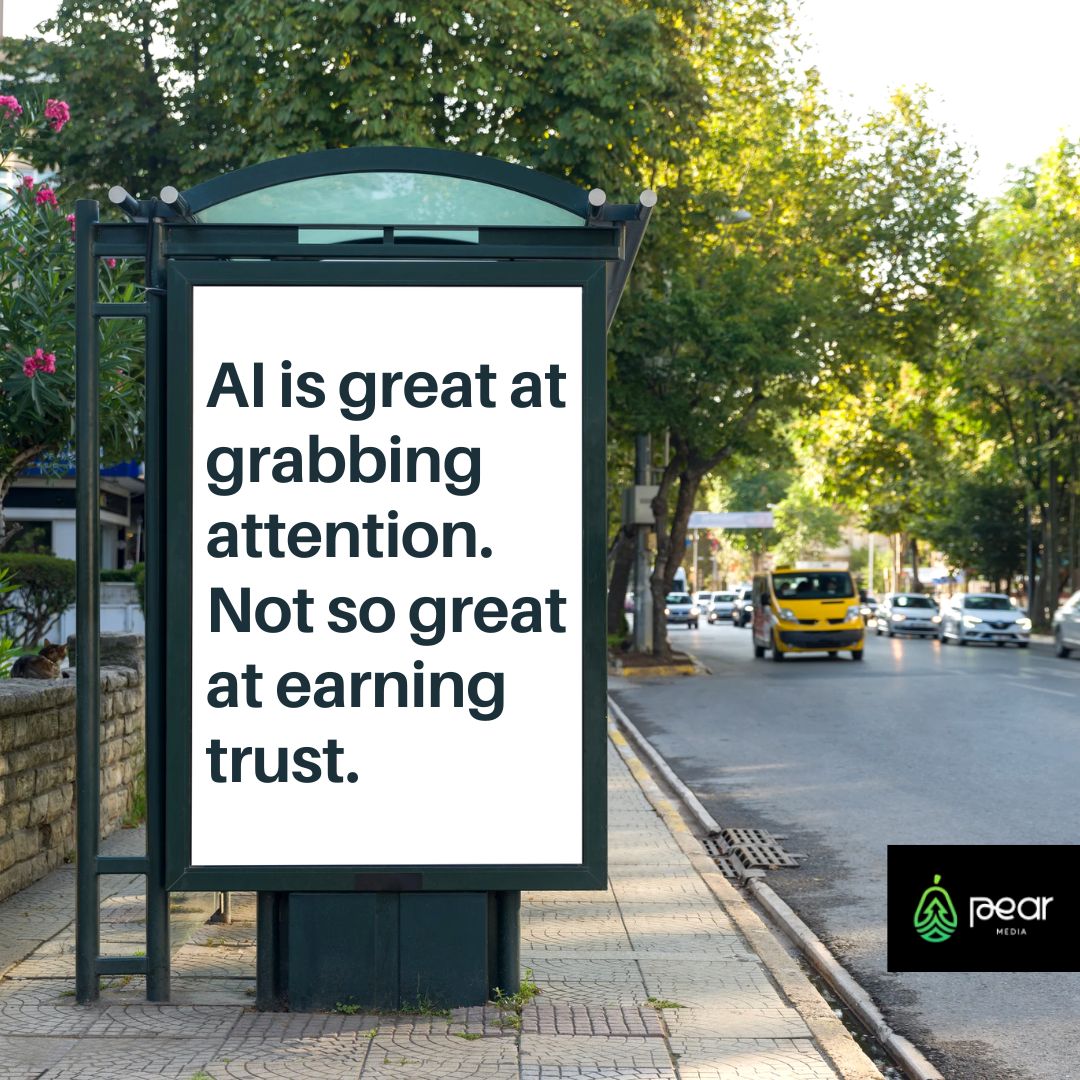

AI ads are getting more clicks... but worse conversions.
We’re seeing patterns like:
~12% higher CTR on Meta
~8% lower conversion on higher AOV products
And the right question is not “is AI good or bad for ads?”
The right question is why does more attention not translate into more revenue?
Here’s what’s actually happening.
AI is extremely strong at pattern recognition and scale-based optimization, which means it learns very quickly what stops people from scrolling, what creates curiosity, what triggers emotional interruption, and what gets engagement signals, but the issue is that all of this mostly lives at the attention layer of the funnel.
Conversions, especially in considered or high-value categories, do not happen at the attention layer. They happen at the belief layer.
That is where things start to break a little.
Because while AI can generate hooks, variations, angles, and even emotional language at scale, it still struggles with deeper things like customer truth, nuanced objections, real-world hesitation, and the kind of narrative structure that builds trust over time instead of just triggering curiosity in the moment.
And this is where most teams misread the data.
They assume “AI ads are working” because CTR is up, but in reality, what’s improving is efficiency of attention capture, not quality of intent formation.
The fix is to separate roles clearly in the creative process.
Let AI handle scale, iteration, and exploration of hooks and variations, but keep humans responsible for positioning, storytelling, and emotional structure, because that is where belief is actually built.
Have you seen this also?
#AIads #AI #metaads #marketing
We’re seeing patterns like:
~12% higher CTR on Meta
~8% lower conversion on higher AOV products
And the right question is not “is AI good or bad for ads?”
The right question is why does more attention not translate into more revenue?
Here’s what’s actually happening.
AI is extremely strong at pattern recognition and scale-based optimization, which means it learns very quickly what stops people from scrolling, what creates curiosity, what triggers emotional interruption, and what gets engagement signals, but the issue is that all of this mostly lives at the attention layer of the funnel.
Conversions, especially in considered or high-value categories, do not happen at the attention layer. They happen at the belief layer.
That is where things start to break a little.
Because while AI can generate hooks, variations, angles, and even emotional language at scale, it still struggles with deeper things like customer truth, nuanced objections, real-world hesitation, and the kind of narrative structure that builds trust over time instead of just triggering curiosity in the moment.
And this is where most teams misread the data.
They assume “AI ads are working” because CTR is up, but in reality, what’s improving is efficiency of attention capture, not quality of intent formation.
The fix is to separate roles clearly in the creative process.
Let AI handle scale, iteration, and exploration of hooks and variations, but keep humans responsible for positioning, storytelling, and emotional structure, because that is where belief is actually built.
Have you seen this also?
#AIads #AI #metaads #marketing
Shared byCasey Shah - 13 days ago
Log in to comment
Loading ..
Related Articles
Overcoming Challenges in Performance Marketing: Exclusive Leads and Retention-Based Payouts

Shifting Affiliate Strategies for Better Retention in Auto Insurance
Simplify Your Marketing Strategy with Essential Tips
Unlock Ad Success: Lessons from 80 Hours of Campaign Analysis
Overlapping Campaigns: The Key to Meta Ad Fatigue and How to Fix It
Scaling Auto Leads: From 50 to 1,200/Month in 8 Weeks with Strategic Media Buying
1
0/100