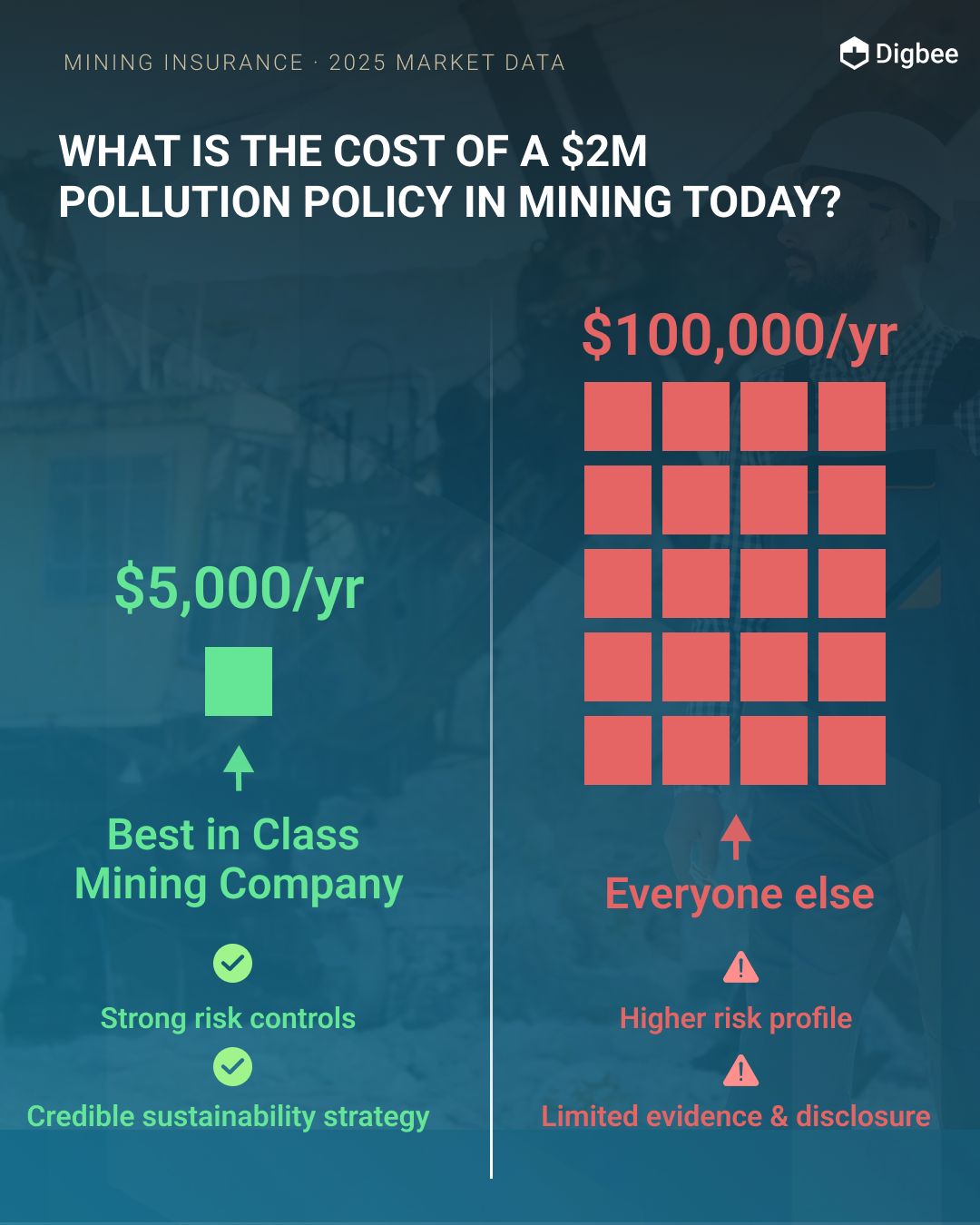

A $2 million mining pollution policy can reportedly cost anywhere from $5,000 to $100,000. Why?
That difference reflects how insurers view the quality of a company’s risk controls, governance, evidence and responsible operating practices.
For years, mining companies have been told that sustainability can create financial value, but the proof has often been hard to isolate. Now it is becoming visible in a place finance teams understand immediately: insurance terms.
The insurance market is quietly repricing mining risk, with brokers and underwriters asking harder questions, requesting more information, and looking closely at tailings, environmental controls, community risk and board oversight. WTW’s Mining Risk Review noted that the Global Industry Standard on Tailings Management is becoming a baseline expectation for underwriters, while Lockton’s 2025 Market Update points to D&O underwriters applying exclusions, limiting cover, or declining certain risks where tailings exposure is present.
That is the part mining teams should pay attention to, because insurers are no longer treating responsibility as a separate reporting exercise. They are treating it as part of risk management. A company that can evidence disciplined tailings governance, clear environmental controls and independent proof behind its disclosures gives the market something solid to assess.
Insurers price what they can see, and the same logic is moving through capital markets.
Insurance premiums may be the most obvious signal because they appear as a line item, but similar questions are now being asked by investors, lenders, strategic partners and acquirers. Can you prove the risk is understood, can you show how it is being managed, and can your claims survive diligence?
For CEOs and CFOs, the last insurance renewal may be more than an operating cost. It may be one of the clearest reads on how the market views the company’s risk profile, and where the cost of weak evidence is starting to appear.
The financial return on responsibility is no longer theoretical. It is showing up in premiums, deductibles, exclusions, diligence timelines, cost of capital and investor confidence.
Proof, not promise.
#Digbee #ResponsibleMining #MiningInvestment #RiskManagement #CapitalMarkets
That difference reflects how insurers view the quality of a company’s risk controls, governance, evidence and responsible operating practices.
For years, mining companies have been told that sustainability can create financial value, but the proof has often been hard to isolate. Now it is becoming visible in a place finance teams understand immediately: insurance terms.
The insurance market is quietly repricing mining risk, with brokers and underwriters asking harder questions, requesting more information, and looking closely at tailings, environmental controls, community risk and board oversight. WTW’s Mining Risk Review noted that the Global Industry Standard on Tailings Management is becoming a baseline expectation for underwriters, while Lockton’s 2025 Market Update points to D&O underwriters applying exclusions, limiting cover, or declining certain risks where tailings exposure is present.
That is the part mining teams should pay attention to, because insurers are no longer treating responsibility as a separate reporting exercise. They are treating it as part of risk management. A company that can evidence disciplined tailings governance, clear environmental controls and independent proof behind its disclosures gives the market something solid to assess.
Insurers price what they can see, and the same logic is moving through capital markets.
Insurance premiums may be the most obvious signal because they appear as a line item, but similar questions are now being asked by investors, lenders, strategic partners and acquirers. Can you prove the risk is understood, can you show how it is being managed, and can your claims survive diligence?
For CEOs and CFOs, the last insurance renewal may be more than an operating cost. It may be one of the clearest reads on how the market views the company’s risk profile, and where the cost of weak evidence is starting to appear.
The financial return on responsibility is no longer theoretical. It is showing up in premiums, deductibles, exclusions, diligence timelines, cost of capital and investor confidence.
Proof, not promise.
#Digbee #ResponsibleMining #MiningInvestment #RiskManagement #CapitalMarkets
Shared byCameron Reyes - 25 days ago
Log in to comment
Loading ..
Related Articles
The Importance of Discipline in Mining Leadership: Insights from Evy Hambro
Overcoming ESG Challenges in Mining M&A with Digbee
The Shift to Responsible Mining: Verification Over Assertion
Unlocking the Hidden Value of Credibility in Mining Investments
Understanding the Critical Copper Supply Challenge for Markets and Policymakers
The Cost of 'We'll Do It Later' in Mining Capital Cycles
3
0/100