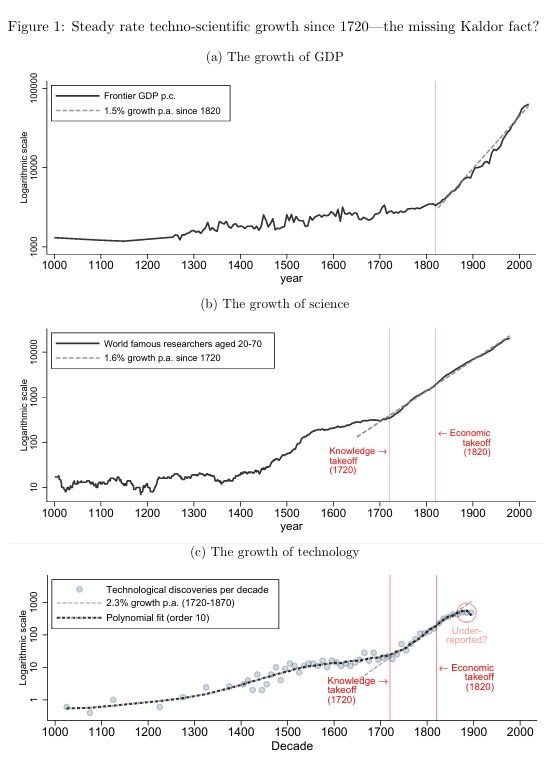

A “new Kaldor Fact” and Growth with Limited (Human) Intelligence by Matías Cabello tackles the puzzle in growth theory: why has long‐run economic growth remained remarkably stable for 200 years, despite dramatic changes in population, education, capital intensity, and scientific institutions?
Cabello uncovers an empirical regularity that economists have largely overlooked: science and technology have grown at a constant rate not just since 1820 (like GDP and population), but since 1720 — a full century earlier. He argues this constitutes a “new Kaldor fact”, one that challenges the foundations of modern growth theory.
To explain this pattern, the paper develops an idea‐network model grounded in cognitive psychology and network theory. The core insight: Idea growth is combinatorial, but the rate of combination is bounded by human cognitive limitations our finite ability to process, associate, and integrate complex ideas.
These cognitive constraints generate a steady, centuries‐long rate of knowledge growth, which in turn anchors the steady rate of economic growth observed since the Industrial Revolution.
The provocative implication: artificial intelligence may dissolve this three‐century‐old regime. If AI systems are not bound by human cognitive limits, the combinatorial frontier of idea production could expand dramatically, potentially altering the long‐run growth path of the global economy.
Read: http://spkl.io/6048A7Nei
#EconomicGrowth #AI #HistoryOfScience #Innovation #GrowthTheory #Macroeconomics #Research
Cabello uncovers an empirical regularity that economists have largely overlooked: science and technology have grown at a constant rate not just since 1820 (like GDP and population), but since 1720 — a full century earlier. He argues this constitutes a “new Kaldor fact”, one that challenges the foundations of modern growth theory.
To explain this pattern, the paper develops an idea‐network model grounded in cognitive psychology and network theory. The core insight: Idea growth is combinatorial, but the rate of combination is bounded by human cognitive limitations our finite ability to process, associate, and integrate complex ideas.
These cognitive constraints generate a steady, centuries‐long rate of knowledge growth, which in turn anchors the steady rate of economic growth observed since the Industrial Revolution.
The provocative implication: artificial intelligence may dissolve this three‐century‐old regime. If AI systems are not bound by human cognitive limits, the combinatorial frontier of idea production could expand dramatically, potentially altering the long‐run growth path of the global economy.
Read: http://spkl.io/6048A7Nei
#EconomicGrowth #AI #HistoryOfScience #Innovation #GrowthTheory #Macroeconomics #Research
Shared byCameron Reyes - 15 days ago
Log in to comment
Loading ..
Related Articles

Impact of For Women Scotland Supreme Court Ruling on Single-Sex Spaces
Global Political Identity and Cultural Preferences: Messi vs. Ronaldo Study

Delaware Corporate Law's Role in Geoengineering Regulation

Authoritarian Shift in International Economic Order: A New Global Landscape

Building Trustworthy AI: Human-Artificial Intelligence Interactions by Beth Coleman

Legal Analysis of Prosecutorial Contempt in U.S. Federal Courts
0/100