Seamless OpenStack Transition: 4-Stage Strategy for Zero Downtime Migration

A "rip-and-replace" cutover is a gamble enterprise businesses can't afford. Here is the exact 4-stage parallel strategy to execute your OpenStack transition without a single minute of production downtime.
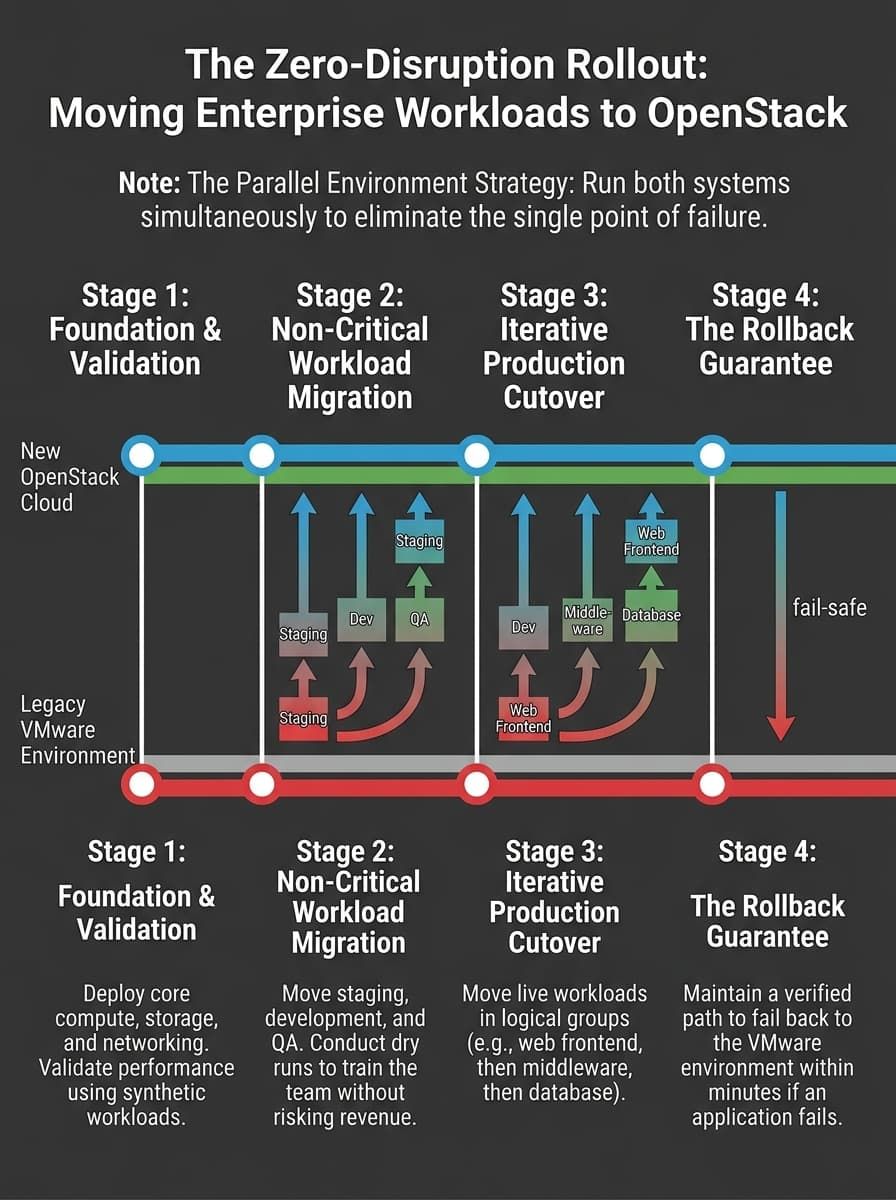
A structured, zero-disruption rollout should follow these staged steps:
Stage 1: Foundation and Validation:
Deploy the core OpenStack infrastructure (compute, storage, networking) and validate it using synthetic workloads. Ensure performance benchmarks match or exceed the legacy environment.
Stage 2: Non-Critical Workload Migration:
Begin by moving staging, development, and QA environments. This acts as a dry run for your migration tools and allows your team to get comfortable with the process without risking production revenue.
Stage 3: Iterative Production Cutover:
Move production workloads in logical application groups (e.g., migrating a web frontend, then its middleware, then the database).
Stage 4: The Rollback Guarantee:
Before any production workload is cut over, establish a verified, tested rollback path. If an application fails to perform on OpenStack, you must be able to fail back to the VMware environment within minutes, not hours.
Read more: https://www.accrets.com/openstack/vmware-to-openstack-migration/
#openstack migration #zero downtime migration #enterprise IT #cloud transition #VMware to OpenStack
A structured, zero-disruption rollout should follow these staged steps:
Stage 1: Foundation and Validation:
Deploy the core OpenStack infrastructure (compute, storage, networking) and validate it using synthetic workloads. Ensure performance benchmarks match or exceed the legacy environment.
Stage 2: Non-Critical Workload Migration:
Begin by moving staging, development, and QA environments. This acts as a dry run for your migration tools and allows your team to get comfortable with the process without risking production revenue.
Stage 3: Iterative Production Cutover:
Move production workloads in logical application groups (e.g., migrating a web frontend, then its middleware, then the database).
Stage 4: The Rollback Guarantee:
Before any production workload is cut over, establish a verified, tested rollback path. If an application fails to perform on OpenStack, you must be able to fail back to the VMware environment within minutes, not hours.
Read more: https://www.accrets.com/openstack/vmware-to-openstack-migration/
#openstack migration #zero downtime migration #enterprise IT #cloud transition #VMware to OpenStack
Shared byBlair Lopez - A month ago
Log in to comment
Loading ..
Related Articles
Mastering Cloud Migration Cutover with a Five-Phase Methodology
Revolutionize Alert Management with AIOps: A Pre-Investment Preview
Overcoming AI Deployment Bottlenecks with Modern Hardware

Streamline Singapore Data Centers: P2V Migration for Cost Efficiency

Transforming IT Operations: Moving Beyond Break-Fix to Strategic Growth
0/100