🧠 Unlocking the "Brain" of Mobile Networks: Core Network Evolution 🌐
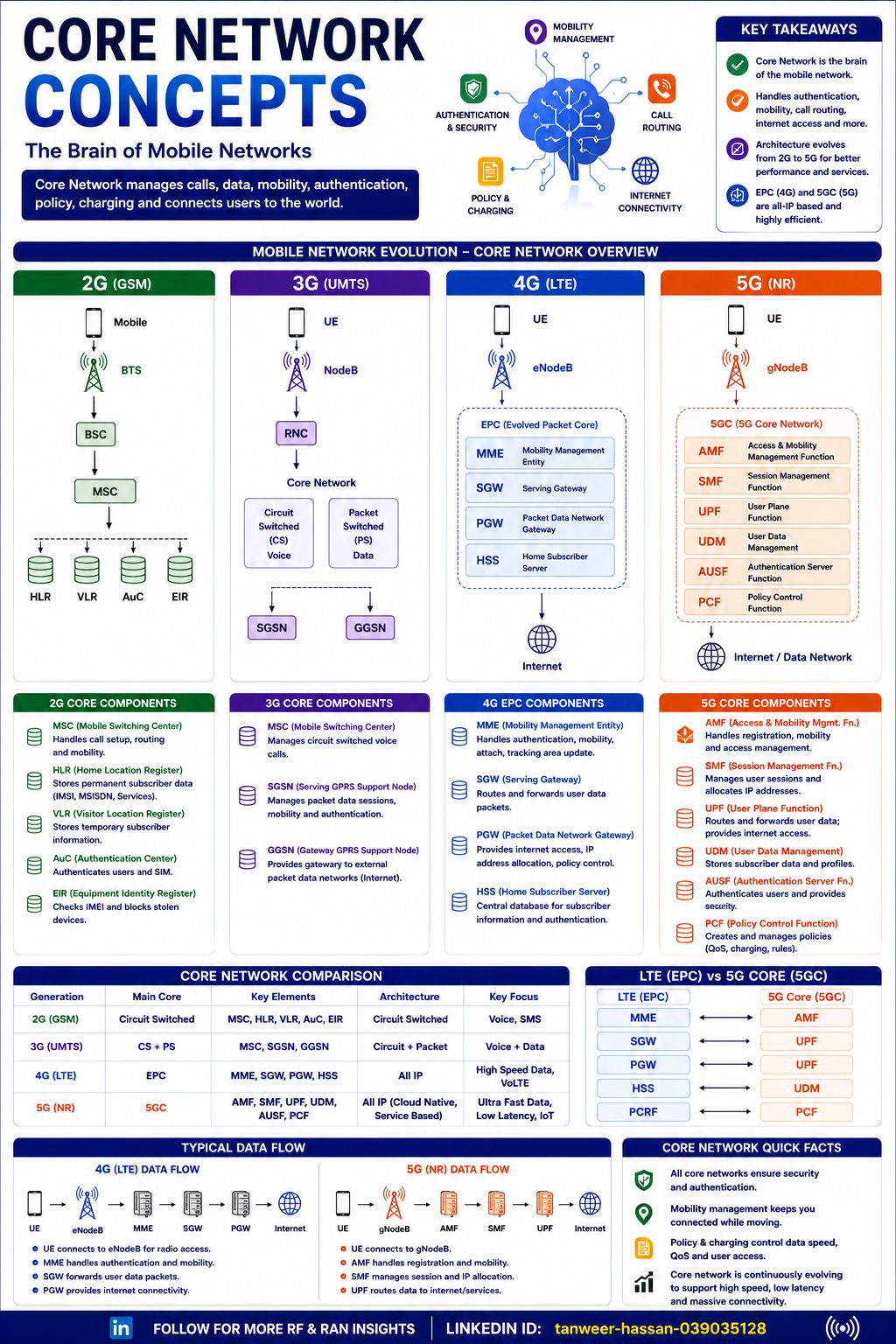
While antennas and cell towers are highly visible, the true intelligence of mobile communication lies within the Core Network. It is the central hub that manages calls, data, mobility, authentication, policy, charging, and connects users to the world.
This exceptional masterclass cheat sheet (referencing file 1000171561.png) traces the incredible architectural evolution of the core from 2G to 5G:
🔹 2G & 3G: The Circuit & Packet Era
* 2G (GSM) relied on a Circuit Switched architecture focused heavily on Voice and SMS services. It utilized legacy components like the MSC, HLR, VLR, AuC, and EIR.
* 3G (UMTS) introduced a dual approach, retaining Circuit Switched nodes for voice while adding a Packet Switched domain (via SGSN and GGSN) to handle early mobile data sessions.
🔹 4G LTE: The All-IP Transformation (EPC)
* 4G revolutionized the core by shifting to an All-IP architecture known as the Evolved Packet Core (EPC).
* Built for high-speed data and VoLTE, it decoupled functions by utilizing the MME for mobility management, the HSS for subscriber data, and the SGW/PGW for routing user data packets to the internet.
🔹 5G NR: The Cloud-Native Future (5GC)
* 5G brings an All-IP, cloud-native, Service-Based Architecture meticulously designed for ultra-fast data, low latency, and massive IoT.
* The architecture maps legacy functions to new, highly agile components: the LTE MME evolved into the 5G AMF (Access & Mobility), while the SGW and PGW data gateways were streamlined into the powerful UPF (User Plane Function).
* Subscriber data moved from the HSS to the UDM, and policy control shifted seamlessly from PCRF to PCF.
💡 The Ultimate Takeaway:
All core networks continuously ensure security, authentication, and mobility management to keep you connected while moving. The evolution into the highly efficient EPC (4G) and 5GC (5G) architectures is what supports the high speed and massive connectivity demands of the modern world.
📌 Save this comprehensive visual guide for your next networking exam, system design review, or RF engineering interview!
#Telecommunications #CoreNetwork #5G #4GLTE #NetworkEngineering #Telecom #WirelessCommunication #EPC #5GC #TechEducation #EngineeringBasics #SystemArchitecture
While antennas and cell towers are highly visible, the true intelligence of mobile communication lies within the Core Network. It is the central hub that manages calls, data, mobility, authentication, policy, charging, and connects users to the world.
This exceptional masterclass cheat sheet (referencing file 1000171561.png) traces the incredible architectural evolution of the core from 2G to 5G:
🔹 2G & 3G: The Circuit & Packet Era
* 2G (GSM) relied on a Circuit Switched architecture focused heavily on Voice and SMS services. It utilized legacy components like the MSC, HLR, VLR, AuC, and EIR.
* 3G (UMTS) introduced a dual approach, retaining Circuit Switched nodes for voice while adding a Packet Switched domain (via SGSN and GGSN) to handle early mobile data sessions.
🔹 4G LTE: The All-IP Transformation (EPC)
* 4G revolutionized the core by shifting to an All-IP architecture known as the Evolved Packet Core (EPC).
* Built for high-speed data and VoLTE, it decoupled functions by utilizing the MME for mobility management, the HSS for subscriber data, and the SGW/PGW for routing user data packets to the internet.
🔹 5G NR: The Cloud-Native Future (5GC)
* 5G brings an All-IP, cloud-native, Service-Based Architecture meticulously designed for ultra-fast data, low latency, and massive IoT.
* The architecture maps legacy functions to new, highly agile components: the LTE MME evolved into the 5G AMF (Access & Mobility), while the SGW and PGW data gateways were streamlined into the powerful UPF (User Plane Function).
* Subscriber data moved from the HSS to the UDM, and policy control shifted seamlessly from PCRF to PCF.
💡 The Ultimate Takeaway:
All core networks continuously ensure security, authentication, and mobility management to keep you connected while moving. The evolution into the highly efficient EPC (4G) and 5GC (5G) architectures is what supports the high speed and massive connectivity demands of the modern world.
📌 Save this comprehensive visual guide for your next networking exam, system design review, or RF engineering interview!
#Telecommunications #CoreNetwork #5G #4GLTE #NetworkEngineering #Telecom #WirelessCommunication #EPC #5GC #TechEducation #EngineeringBasics #SystemArchitecture
Shared byJamie Kim - 11 hours ago
Log in to comment
Loading ..
Related Articles
Revolutionize Telecom Engineering: Beyond Single Signal Tracking

Safeguard Your Work with AI: Essential Do's & Don'ts for Using Personal AI at Work

Master Skills Effortlessly with Claude: 6 Effective Learning Prompts
Understanding PRB Utilization: Key to Network Health
Demystifying AI: How It Works and Why Understanding It Matters
Understanding 5G NSA vs 5G SA: A Comprehensive Overview
142
0/100