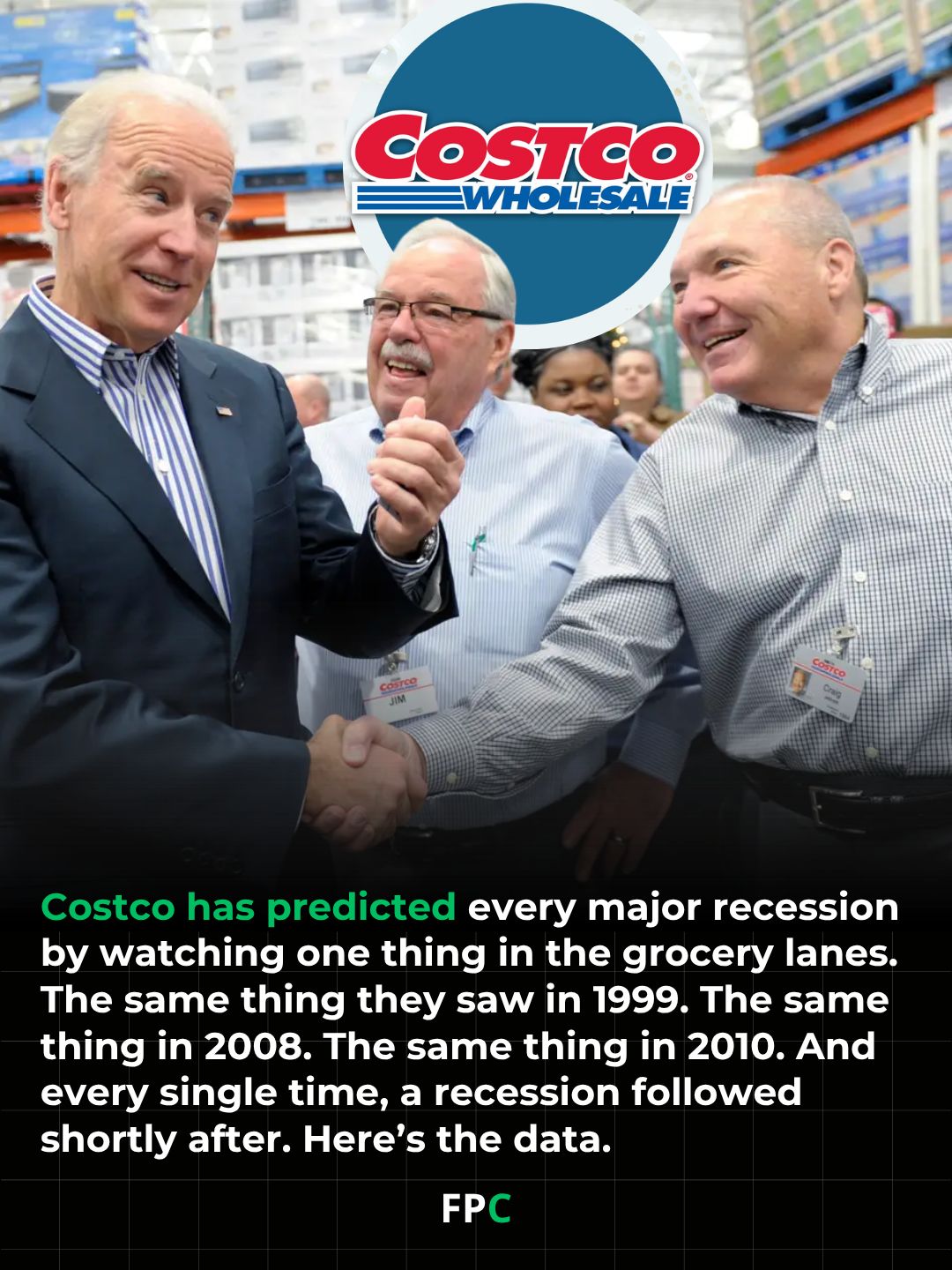

Costco has predicted every major recession by watching one thing in the grocery lanes. The same thing they saw in 1999.
The same thing in 2008. The same thing in 2010.
And every single time, a recession followed shortly after. Here’s the data:
The signal is not complicated.
When people start switching from beef to chicken, Costco pays attention.
When they switch from chicken to canned tuna — Costco gets worried.
That one buying habit has predicted every major recession they have ever seen.
Costco does not wait for government reports.
They do not read Wall Street forecasts.
They watch what millions of ordinary people are actually putting in their shopping carts every single week.
That data is more honest than any report.
Costco CFO Richard Galanti said it directly.
“Within fresh protein — we always see in a recession a shift from beef to poultry and pork.”
They are seeing that shift right now.
Beef prices went up 17.6% this year.
The supply of cattle herds was low.
Low supply drove prices higher.
When beef became too expensive — people started making different choices at the checkout.
Costco watched every single one of them.
It did not stop at chicken.
Costco's head of food and sundry reported that customers were switching even to canned chicken and canned tuna.
That is not a preference shift.
That is a budget shift.
And budget shifts precede recessions.
Costco was not the only one seeing this.
McDonald's's CEO reported the same pattern.
People were leaving Applebee's, Red Robin and Chili's — restaurants that cost more — and coming back to McDonald's.
Two different companies.
The exact same signal.
Two things are happening at the same time.
Beef prices are up 17.6%.
And wages have not kept pace with inflation.
When prices rise faster than pay, people do not complain.
They just quietly change what they buy.
This is not just about one grocery run.
It is the cumulative impact of years of rising prices on people who are still earning roughly the same.
Eventually, the budget breaks.
And the first place it shows up is in the meat section at Costco.
There is another early recession signal that economists track informally.
When people stop spending on non-essential items — entertainment, nights out, luxury treats — that discretionary spending drop almost always appears before the official recession data does.
Regular people feel it first.
Recessions do not announce themselves.
They appear first in small, quiet behaviour changes.
What people eat. Where people eat.
What they stop buying.
By the time the official data confirms a recession — most people are already living inside one.
The people who survive recessions best are not the ones who react when it hits.
They are the ones who saw the signals early and made decisions before everyone else did.
Build your emergency fund.
Reduce unnecessary expenses.
Protect your income streams now.
Thank you for reading!
Follow First Principles Consultants for more.
#economic forecasting #recession indicators #consumer behavior #Costco insights #financial trends
The same thing in 2008. The same thing in 2010.
And every single time, a recession followed shortly after. Here’s the data:
The signal is not complicated.
When people start switching from beef to chicken, Costco pays attention.
When they switch from chicken to canned tuna — Costco gets worried.
That one buying habit has predicted every major recession they have ever seen.
Costco does not wait for government reports.
They do not read Wall Street forecasts.
They watch what millions of ordinary people are actually putting in their shopping carts every single week.
That data is more honest than any report.
Costco CFO Richard Galanti said it directly.
“Within fresh protein — we always see in a recession a shift from beef to poultry and pork.”
They are seeing that shift right now.
Beef prices went up 17.6% this year.
The supply of cattle herds was low.
Low supply drove prices higher.
When beef became too expensive — people started making different choices at the checkout.
Costco watched every single one of them.
It did not stop at chicken.
Costco's head of food and sundry reported that customers were switching even to canned chicken and canned tuna.
That is not a preference shift.
That is a budget shift.
And budget shifts precede recessions.
Costco was not the only one seeing this.
McDonald's's CEO reported the same pattern.
People were leaving Applebee's, Red Robin and Chili's — restaurants that cost more — and coming back to McDonald's.
Two different companies.
The exact same signal.
Two things are happening at the same time.
Beef prices are up 17.6%.
And wages have not kept pace with inflation.
When prices rise faster than pay, people do not complain.
They just quietly change what they buy.
This is not just about one grocery run.
It is the cumulative impact of years of rising prices on people who are still earning roughly the same.
Eventually, the budget breaks.
And the first place it shows up is in the meat section at Costco.
There is another early recession signal that economists track informally.
When people stop spending on non-essential items — entertainment, nights out, luxury treats — that discretionary spending drop almost always appears before the official recession data does.
Regular people feel it first.
Recessions do not announce themselves.
They appear first in small, quiet behaviour changes.
What people eat. Where people eat.
What they stop buying.
By the time the official data confirms a recession — most people are already living inside one.
The people who survive recessions best are not the ones who react when it hits.
They are the ones who saw the signals early and made decisions before everyone else did.
Build your emergency fund.
Reduce unnecessary expenses.
Protect your income streams now.
Thank you for reading!
Follow First Principles Consultants for more.
#economic forecasting #recession indicators #consumer behavior #Costco insights #financial trends
Shared byCasey Lopez - 6 days ago
Log in to comment
Loading ..
Related Articles
Overcoming the Midlife Squeeze: Ray Dalio's Leverage Strategy for Success
Unlocking the Unique Advantages of ADHD: Careers and Skills for Thriving

Master Premortem: Predicting Failures Before They Happen with AI

Unlock Productivity with ADHD Executive Function Mode: Task Hacks & Dopamine Boosts
The Most Dangerous Sleep Experiment: What Randy Gardner Taught Us About Consciousness
Understanding ADHD: The Science Behind Task Initiation and Neural Regulation
4
0/100