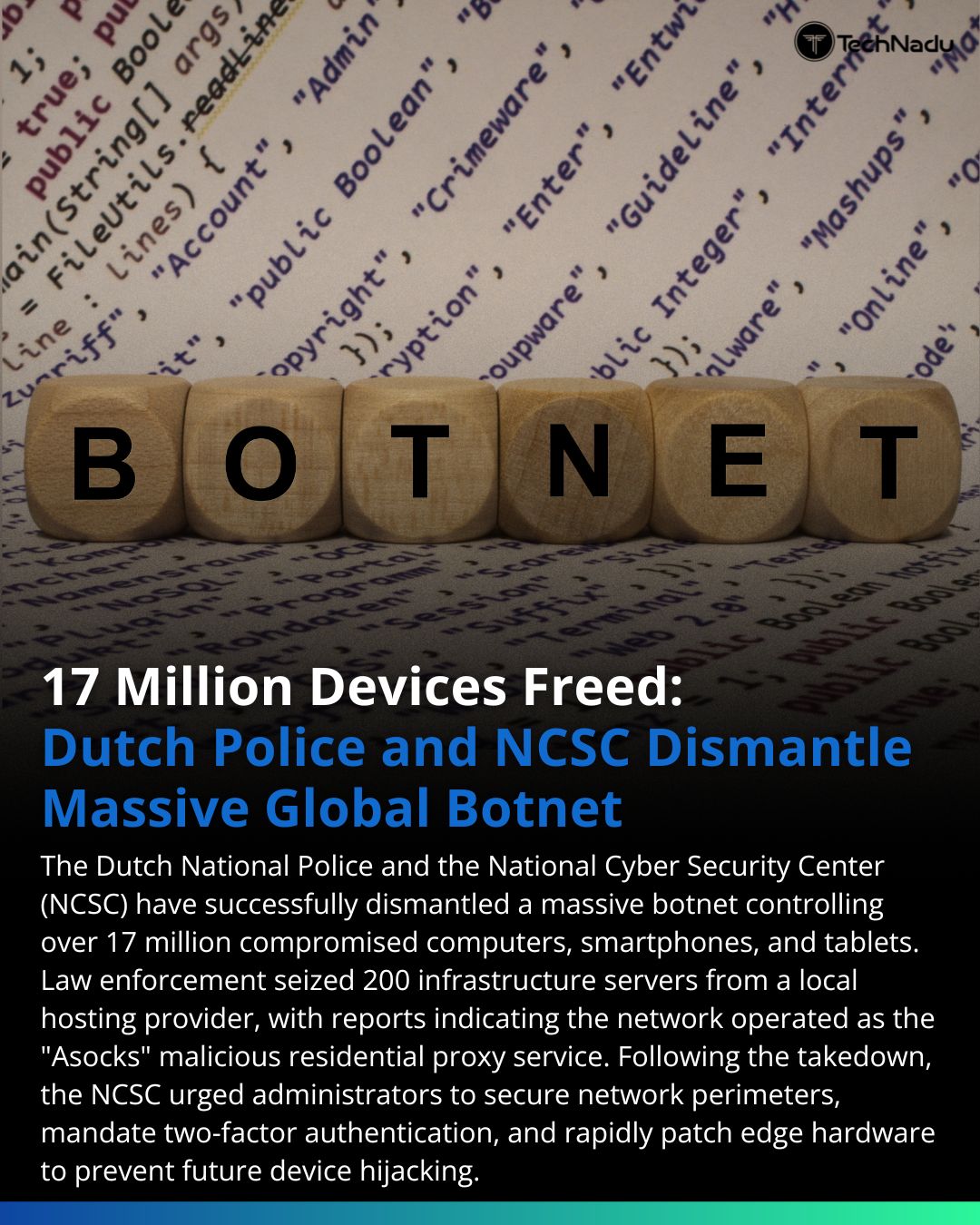

Seventeen million compromised devices. Let that number sink in for a moment.
Behind that figure was a botnet infrastructure spread across 200 servers in the Netherlands, quietly controlling infected computers, smartphones, and tablets until a joint operation by Dutch Police and the National Cyber Security Center (NCSC) brought it down. 👉
What stands out is how the investigation began. A security researcher spotted suspicious activity and reported it, triggering a forensic investigation that ultimately led to the seizure of infrastructure allegedly being used for cybercriminal operations. Some reports suggest the operation targeted the Asocks network, a service associated with residential proxy activity.
The scale is a reminder that botnets are no longer limited to compromised PCs. Phones, tablets, routers, and other connected devices can all become part of a criminal ecosystem without their owners realizing it.
The guidance from the NCSC is familiar, but incidents like this show why it matters: patch systems promptly, enable two-factor authentication, replace default passwords, secure Wi-Fi networks, and maintain visibility across every connected device.
The biggest cybersecurity stories aren't always the breaches that make headlines. Sometimes they're the millions of infected devices operating in the background, powering attacks against others.
Do you think organizations and consumers are doing enough to monitor the growing number of connected devices on their networks, or is device visibility still one of cybersecurity's biggest blind spots?
#Cybersecurity #Botnet #ThreatIntelligence #InfoSec #CyberDefense
Behind that figure was a botnet infrastructure spread across 200 servers in the Netherlands, quietly controlling infected computers, smartphones, and tablets until a joint operation by Dutch Police and the National Cyber Security Center (NCSC) brought it down. 👉
What stands out is how the investigation began. A security researcher spotted suspicious activity and reported it, triggering a forensic investigation that ultimately led to the seizure of infrastructure allegedly being used for cybercriminal operations. Some reports suggest the operation targeted the Asocks network, a service associated with residential proxy activity.
The scale is a reminder that botnets are no longer limited to compromised PCs. Phones, tablets, routers, and other connected devices can all become part of a criminal ecosystem without their owners realizing it.
The guidance from the NCSC is familiar, but incidents like this show why it matters: patch systems promptly, enable two-factor authentication, replace default passwords, secure Wi-Fi networks, and maintain visibility across every connected device.
The biggest cybersecurity stories aren't always the breaches that make headlines. Sometimes they're the millions of infected devices operating in the background, powering attacks against others.
Do you think organizations and consumers are doing enough to monitor the growing number of connected devices on their networks, or is device visibility still one of cybersecurity's biggest blind spots?
#Cybersecurity #Botnet #ThreatIntelligence #InfoSec #CyberDefense
Shared byKendall Nguyen - 3 days ago
Log in to comment
Loading ..
Related Articles

Albina Iljasov Appointed Co-CEO of XCharge, Expanding Cybersecurity Role

Arthur Boilanger Promoted to Information Security Engineer at Deepwatch

Joe Giannetti Appointed as Lexitas' Chief Information Officer & Chief Information Security Officer

Phishing Kits Evolving Rapidly: New Threats and Detection Strategies

Darryl van Rensburg Joins Spectrum Consulting as Business Development Director
AI-Driven Security Challenges: Context Collapse and Blind Spots in Bugcrowd's Insights
0/100