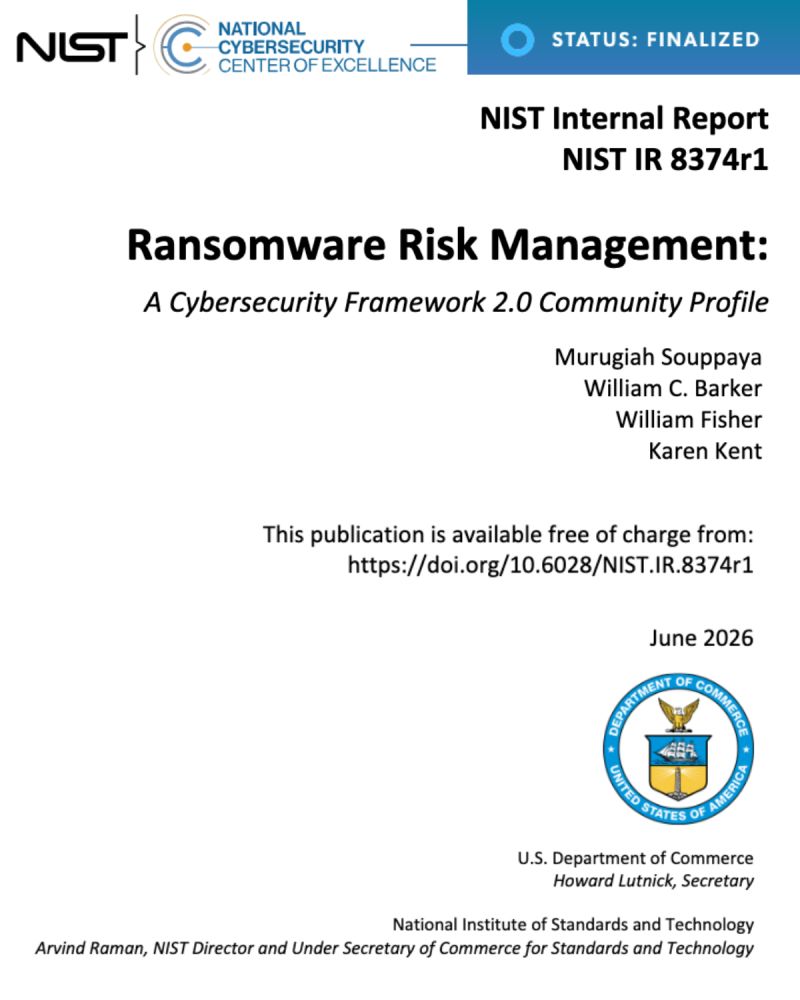
Mastering Ransomware Risk Management with Updated NIST CSF 2.0

[CYBER RESILIENCE] Updated NIST CSF 2.0 Ransomware Risk Management: Develop Your Playbook
i️ The "NIST Interagency Report (IR) 8374 Revision 1, Ransomware Risk Management: A Cybersecurity Framework (CSF) 2.0 Community Profile" is a practical guide that helps organizations manage ransomware risks using the NIST CSF 2.0, replacing the 2022 version based on NIST CSF 1.1.
i️ The guide helps organizations focus on the cybersecurity outcomes that matter most for ransomware prevention, preparedness, response, and recovery. Instead of treating ransomware only as a technical malware problem, NIST frames it as an enterprise risk and operational resilience issue.
i️ It's intended for organizations of any size or sector, including industry, government, and nonprofits. NIST highlights that it can be especially useful for small and less-resourced organizations because it provides a prioritized starting point.
📍 MAIN PRACTICAL USES
✅ Assess current ransomware readiness: Identify where the organization stands today.
✅ Define a target state: Establish what “good enough” ransomware resilience should look like.
✅ Identify gaps: Compare current vs. target capabilities.
✅ Prioritize improvements: Focus first on the controls and outcomes that most reduce ransomware impact.
✅ Build a ransomware countermeasure playbook: Use the CSF outcomes to guide prevention, response, recovery, and decision-making.
The NIST Ransomware CSF Community Profile is a ransomware-focused roadmap for translating CSF 2.0 into concrete governance, protection, detection, response, and recovery outcomes. Its value is not only technical. It helps leaders prioritize ransomware resilience as a business risk-management issue.
📌 NIST IR 8374 r1 Ransomware Risk Management: A Cybersecurity Framework 2.0 Community Profile
🔗
#ransomware #nist #csf #risk #riskmanagement #threathunting #threatdetection #threatanalysis #threatintelligence #cyberthreatintelligence #cyberintelligence #cybersecurity #cyberprotection #cyberdefense
i️ The "NIST Interagency Report (IR) 8374 Revision 1, Ransomware Risk Management: A Cybersecurity Framework (CSF) 2.0 Community Profile" is a practical guide that helps organizations manage ransomware risks using the NIST CSF 2.0, replacing the 2022 version based on NIST CSF 1.1.
i️ The guide helps organizations focus on the cybersecurity outcomes that matter most for ransomware prevention, preparedness, response, and recovery. Instead of treating ransomware only as a technical malware problem, NIST frames it as an enterprise risk and operational resilience issue.
i️ It's intended for organizations of any size or sector, including industry, government, and nonprofits. NIST highlights that it can be especially useful for small and less-resourced organizations because it provides a prioritized starting point.
📍 MAIN PRACTICAL USES
✅ Assess current ransomware readiness: Identify where the organization stands today.
✅ Define a target state: Establish what “good enough” ransomware resilience should look like.
✅ Identify gaps: Compare current vs. target capabilities.
✅ Prioritize improvements: Focus first on the controls and outcomes that most reduce ransomware impact.
✅ Build a ransomware countermeasure playbook: Use the CSF outcomes to guide prevention, response, recovery, and decision-making.
The NIST Ransomware CSF Community Profile is a ransomware-focused roadmap for translating CSF 2.0 into concrete governance, protection, detection, response, and recovery outcomes. Its value is not only technical. It helps leaders prioritize ransomware resilience as a business risk-management issue.
📌 NIST IR 8374 r1 Ransomware Risk Management: A Cybersecurity Framework 2.0 Community Profile
🔗
#ransomware #nist #csf #risk #riskmanagement #threathunting #threatdetection #threatanalysis #threatintelligence #cyberthreatintelligence #cyberintelligence #cybersecurity #cyberprotection #cyberdefense
Shared byKai Chen - 4 days ago
Log in to comment
Loading ..
Related Articles

Building Holistic Security: Insights from the KRITIS Conference 2026

NIS-2 Registration Deadline Extended to July 31, 2026: What Businesses Need to Know

Join Consultant Days 2026 for Next-Level Data Center Engineering Insights
National Risk Analysis in Austria: A Comprehensive Look at EU CER Implementation

Anthropic's Claude Fable 5 Jailbreak Reveals Stack Exploits

Integrative Implementation of KRITIS-Dachgesetz by Rheinbahn AG
260
0/100