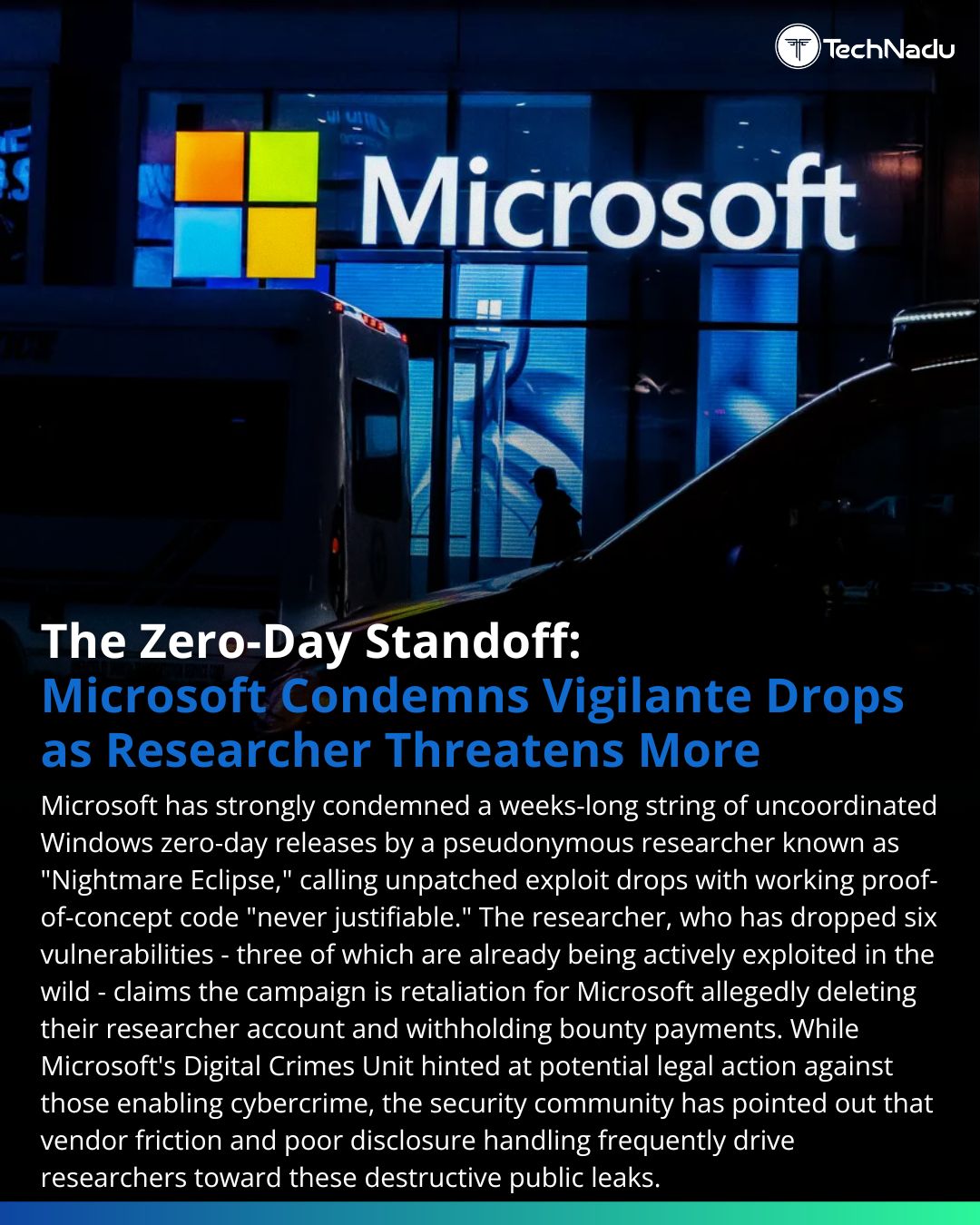

What happens when a security researcher starts publishing Windows zero-days with working exploit code before patches exist?
That's the debate Microsoft is now confronting after a months-long campaign of uncoordinated vulnerability disclosures that has already led to multiple exploited flaws and a public war of words between the company and a pseudonymous researcher.
Microsoft's response was unusually direct: releasing proof-of-concept code for unpatched vulnerabilities is "never justifiable" and creates real-world risk for customers. The company also emphasized that its Digital Crimes Unit continues pursuing threat actors and those who enable cybercrime.
The backdrop makes the story even more complicated. Three of the six vulnerabilities released so far were reportedly exploited in real-world attacks and have been added to Cybersecurity and Infrastructure Security Agency CISA's Known Exploited Vulnerabilities catalog. Meanwhile, the researcher behind the disclosures claims disputes over bug bounty payments, account actions, and attribution helped fuel the conflict.
The incident has also reignited a broader conversation across the security industry. Over the years, several researchers and security firms have publicly criticized major vendors, including Microsoft, over disclosure processes, patch timelines, communication, and researcher recognition.
At its core, this isn't just a story about one researcher or one vendor. It's about a question the cybersecurity community continues to wrestle with: when trust breaks down between researchers and software providers, who ultimately pays the price?
Where do you stand on the balance between coordinated disclosure and public pressure when critical vulnerabilities are involved?
Source:
#CyberSecurity #Microsoft #ZeroDay #VulnerabilityDisclosure #InfoSec
That's the debate Microsoft is now confronting after a months-long campaign of uncoordinated vulnerability disclosures that has already led to multiple exploited flaws and a public war of words between the company and a pseudonymous researcher.
Microsoft's response was unusually direct: releasing proof-of-concept code for unpatched vulnerabilities is "never justifiable" and creates real-world risk for customers. The company also emphasized that its Digital Crimes Unit continues pursuing threat actors and those who enable cybercrime.
The backdrop makes the story even more complicated. Three of the six vulnerabilities released so far were reportedly exploited in real-world attacks and have been added to Cybersecurity and Infrastructure Security Agency CISA's Known Exploited Vulnerabilities catalog. Meanwhile, the researcher behind the disclosures claims disputes over bug bounty payments, account actions, and attribution helped fuel the conflict.
The incident has also reignited a broader conversation across the security industry. Over the years, several researchers and security firms have publicly criticized major vendors, including Microsoft, over disclosure processes, patch timelines, communication, and researcher recognition.
At its core, this isn't just a story about one researcher or one vendor. It's about a question the cybersecurity community continues to wrestle with: when trust breaks down between researchers and software providers, who ultimately pays the price?
Where do you stand on the balance between coordinated disclosure and public pressure when critical vulnerabilities are involved?
Source:
#CyberSecurity #Microsoft #ZeroDay #VulnerabilityDisclosure #InfoSec
Shared byJordan Reid - 4 days ago
Log in to comment
Loading ..
Related Articles

Albina Iljasov Appointed Co-CEO of XCharge, Expanding Cybersecurity Role

Arthur Boilanger Promoted to Information Security Engineer at Deepwatch

Joe Giannetti Appointed as Lexitas' Chief Information Officer & Chief Information Security Officer

Phishing Kits Evolving Rapidly: New Threats and Detection Strategies

Darryl van Rensburg Joins Spectrum Consulting as Business Development Director

AI-Driven Security Challenges: Context Collapse and Blind Spots in Bugcrowd's Insights
0/100