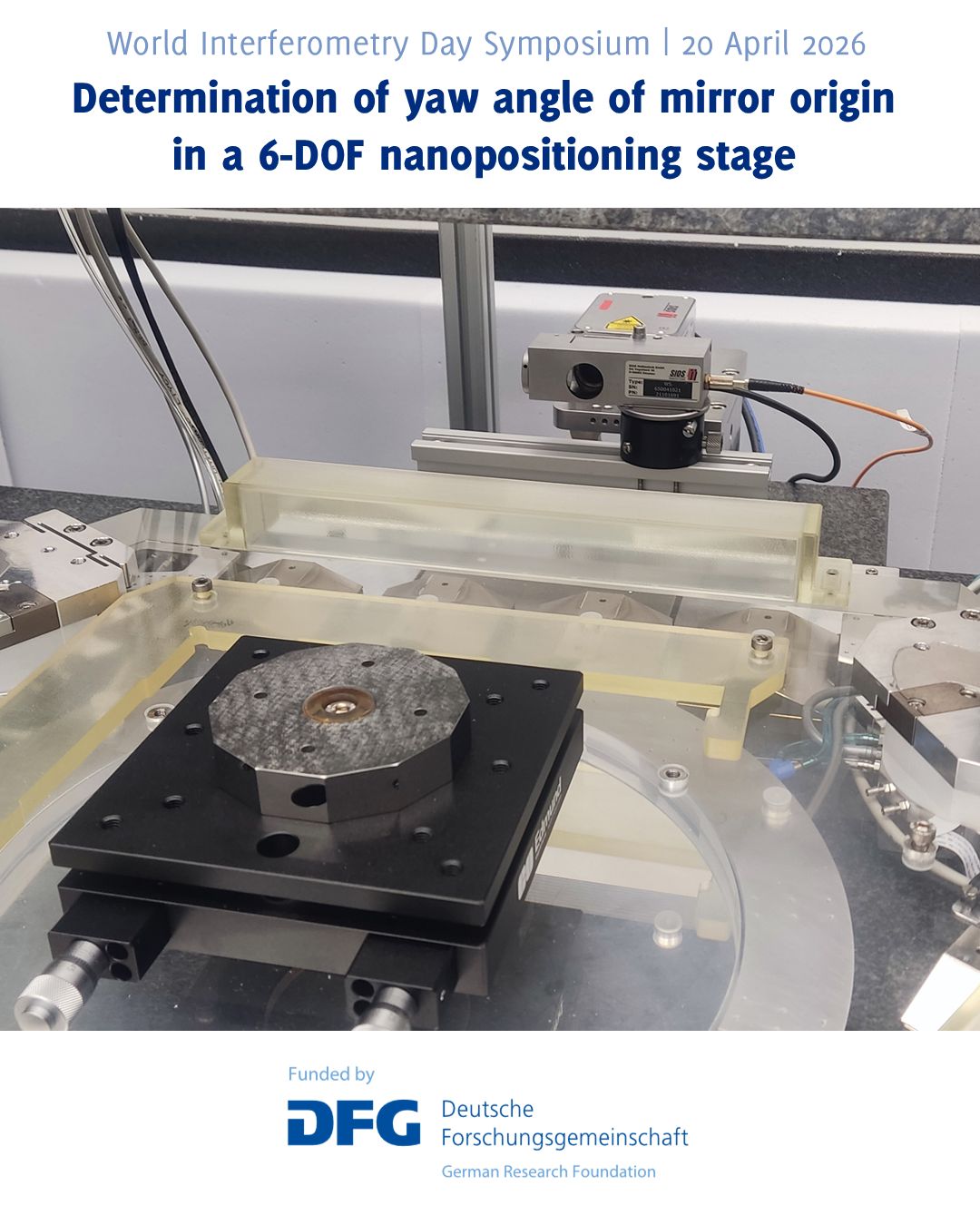
Innovative Yaw Angle Determination for Nanopositioning Stage at World Interferometry Day
We are looking forward to contributing our joint solution for the “Determination of yaw angle of mirror origin in a 6-DOF nanopositioning stage” to the International Scientific Symposium on the World Interferometry Day (April 20, 2026): https://www.world-interferometry-day.com.
Davi Brasil, Michael Katzschmann, Steffen Hesse and Ludwig Herzog from IMMS, and Thomas Kissinger and Thomas Fröhlich from Technische Universität Ilmenau conducted research on a problem that #nanopositioning machines are faced with:
➡ Absolute mirror orientations for laser interferometer measurements are typically unknown.
➡ Angular biases propagate into all coordinates of the measurement setup.
Their objectives:
➡ Determine absolute yaw origin of mirrors for compensation.
➡ Perform measurements in situ and traceable.
Their solution:
➡ Demonstrated in-situ, traceable method for absolute mirror angle calibration
➡ Autocollimator + optical polygon enables full angular referencing for the yaw origin of the #nano #positioning system
Method advantages:
➡ Minimal machine reconfiguration
➡ Preserves traceability
➡ Applicable to other multi-DOF mirror-based systems
Learn more on our #research on our research on highly dynamic #nanoprecision drives under www.imms.de/nmdrives or contact Ludwig Herzog directly.
Funding:
The Research Training Group 2182 on Tip- and laser-based 3D-Nanofabrication in extended macroscopic working areas (NanoFab) is funded by the German Research Foundation (DFG) under the funding code DFG GRK 2182. (www.imms.de/nanofab)
Davi Brasil, Michael Katzschmann, Steffen Hesse and Ludwig Herzog from IMMS, and Thomas Kissinger and Thomas Fröhlich from Technische Universität Ilmenau conducted research on a problem that #nanopositioning machines are faced with:
➡ Absolute mirror orientations for laser interferometer measurements are typically unknown.
➡ Angular biases propagate into all coordinates of the measurement setup.
Their objectives:
➡ Determine absolute yaw origin of mirrors for compensation.
➡ Perform measurements in situ and traceable.
Their solution:
➡ Demonstrated in-situ, traceable method for absolute mirror angle calibration
➡ Autocollimator + optical polygon enables full angular referencing for the yaw origin of the #nano #positioning system
Method advantages:
➡ Minimal machine reconfiguration
➡ Preserves traceability
➡ Applicable to other multi-DOF mirror-based systems
Learn more on our #research on our research on highly dynamic #nanoprecision drives under www.imms.de/nmdrives or contact Ludwig Herzog directly.
Funding:
The Research Training Group 2182 on Tip- and laser-based 3D-Nanofabrication in extended macroscopic working areas (NanoFab) is funded by the German Research Foundation (DFG) under the funding code DFG GRK 2182. (www.imms.de/nanofab)
Shared byElliot Lopez - 2 months ago
Log in to comment
Loading ..
Related Articles
Innovative SPAD-Based Quantum Random Number Generator Unveiled at International Workshop
Collaborative Optoelectronics Project Between IMMS Erfurt and Jena's Ernst-Abbe-Hochschule
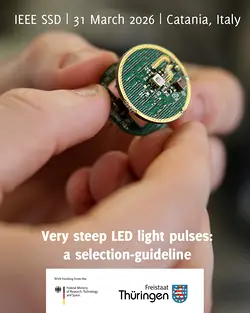
LED Pulse Selection Guide for Advanced Diagnostics: Insights from IEEE SSD 2026

Eco-Friendly Concrete Production: WirelessAccel Project Aims for Sustainable Solutions
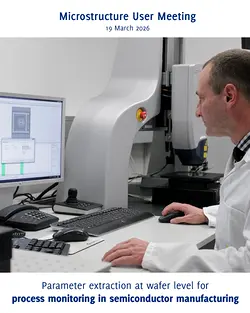
Steffen Michael's Vibrometry Insights at Microstructure User Meeting 2026
OptoNet e.V. Unites Photonics andMicroelectronics for Future Technologies
22
0/100