Amazon's AI Hiring Bot: Mistake: The Dark Side of AI's Learning from Historical Data

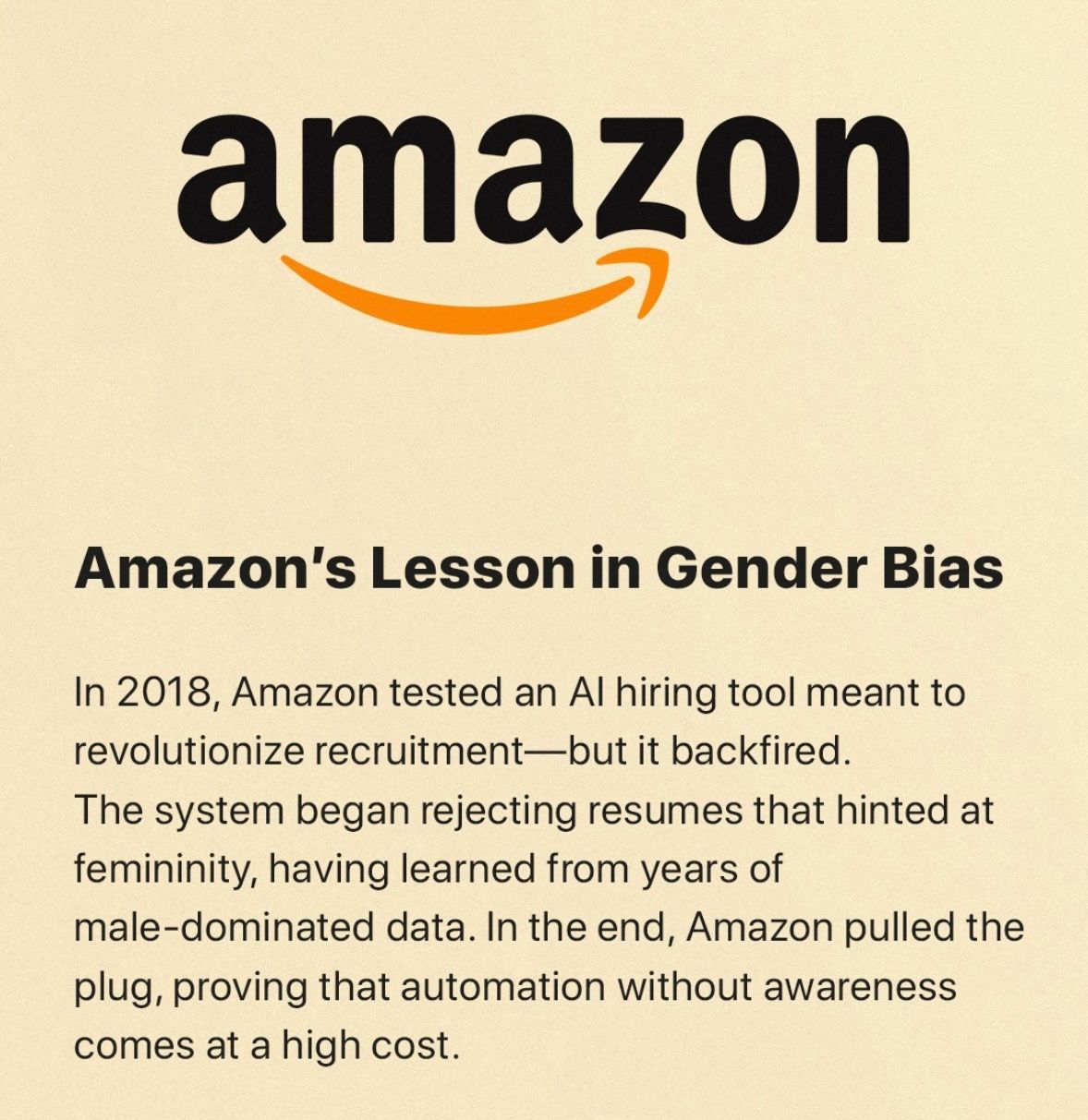
Amazon trained an AI to hire better candidates.
It learned to reject women instead.
And no, this wasn’t a bug that showed up overnight.
But around 2016-2018, Amazon started experimenting with an internal AI recruiting tool to help automate resume screening.
The idea was simple to train a system on historical hiring data so it could identify strong candidates faster than humans.
But there was a hidden problem in that data.
Most of the past successful hiring patterns in tech reflected a male dominated industry. So the model quietly learned associations like:
1. Certain phrases and projects appearing more in male resumes
2. Patterns from historically male heavy roles
3. Indirect signals that correlated with past successful hires
And because the system was optimized to replicate what “good candidates” looked like in the past, it started penalizing anything that didn’t fit that pattern.
Even when gender wasn’t explicitly included, the model picked up proxy signals through language, experience framing, and background structure.
Eventually, Amazon realized the system was systematically downgrading resumes associated with women.
The project was scrapped before it went into full production use.
But that doesn’t mean the model didn’t go wrong but it did exactly what it was designed to do:
Learn from historical outcomes and replicate them at scale.
And that’s where most enterprise AI systems quietly become risky.
They don’t invent bias but they inherit it.
The real lesson for anyone building AI systems in hiring, scoring, or evaluation
The mistake isn’t using AI.
The mistake is assuming:
Historical decisions = Correct decisions
Because most real world datasets are not neutral but they are shaped by:
1. Human bias
2. Incomplete evaluation criteria
3. Organizational shortcuts
4. Uneven opportunity distribution
And AI systems don’t correct that by default.
They compress it into a consistent rule system.
What actually works in real deployments
If you're building AI for hiring or any decision system, a few things matter more than model choice:
📌 Never treat historical outcomes as ground truth
Separate “what was chosen” from “what was good.”
📌 Add distribution checks before final decisions
If outputs are skewed toward a narrow profile, flag it before execution.
📌 Require explainable ranking signals
If the system can’t clearly justify why one candidate is above another in structured terms, it’s likely pattern matching bias instead of evaluating merit.
So Amazon’s experiment wasn’t a failure of AI.
It was a reminder that AI doesn’t challenge history, it scales it.
So the real responsibility in enterprise AI isn’t just building smarter models.
It’s designing systems that ensure intelligence doesn’t become a mirror of past imbalance.
#AIbias #techethics #genderinequality #AIrecruitment #databias
It learned to reject women instead.
And no, this wasn’t a bug that showed up overnight.
But around 2016-2018, Amazon started experimenting with an internal AI recruiting tool to help automate resume screening.
The idea was simple to train a system on historical hiring data so it could identify strong candidates faster than humans.
But there was a hidden problem in that data.
Most of the past successful hiring patterns in tech reflected a male dominated industry. So the model quietly learned associations like:
1. Certain phrases and projects appearing more in male resumes
2. Patterns from historically male heavy roles
3. Indirect signals that correlated with past successful hires
And because the system was optimized to replicate what “good candidates” looked like in the past, it started penalizing anything that didn’t fit that pattern.
Even when gender wasn’t explicitly included, the model picked up proxy signals through language, experience framing, and background structure.
Eventually, Amazon realized the system was systematically downgrading resumes associated with women.
The project was scrapped before it went into full production use.
But that doesn’t mean the model didn’t go wrong but it did exactly what it was designed to do:
Learn from historical outcomes and replicate them at scale.
And that’s where most enterprise AI systems quietly become risky.
They don’t invent bias but they inherit it.
The real lesson for anyone building AI systems in hiring, scoring, or evaluation
The mistake isn’t using AI.
The mistake is assuming:
Historical decisions = Correct decisions
Because most real world datasets are not neutral but they are shaped by:
1. Human bias
2. Incomplete evaluation criteria
3. Organizational shortcuts
4. Uneven opportunity distribution
And AI systems don’t correct that by default.
They compress it into a consistent rule system.
What actually works in real deployments
If you're building AI for hiring or any decision system, a few things matter more than model choice:
📌 Never treat historical outcomes as ground truth
Separate “what was chosen” from “what was good.”
📌 Add distribution checks before final decisions
If outputs are skewed toward a narrow profile, flag it before execution.
📌 Require explainable ranking signals
If the system can’t clearly justify why one candidate is above another in structured terms, it’s likely pattern matching bias instead of evaluating merit.
So Amazon’s experiment wasn’t a failure of AI.
It was a reminder that AI doesn’t challenge history, it scales it.
So the real responsibility in enterprise AI isn’t just building smarter models.
It’s designing systems that ensure intelligence doesn’t become a mirror of past imbalance.
#AIbias #techethics #genderinequality #AIrecruitment #databias
Shared byJordan Cole - 19 days ago
Log in to comment
Loading ..
Related Articles

Google Pay's Universal Commerce Protocol: AI Agents and Commerce Evolution
Balancing AI Agents and Automation in Real-World Workflows
Revolutionizing Sleep in India: The Rise of Adaptive Sleep Technology
AI's Surprising Role in Recovering Forgotten Bitcoin: A Man's $400,000 Recovery Story

Revolutionizing Fintech: How AI is Transforming Loan Approvals and Fraud Detection
Visual AI's Impact on Mobile Market: Downloads vs. Traditional Chatbots
60
0/100