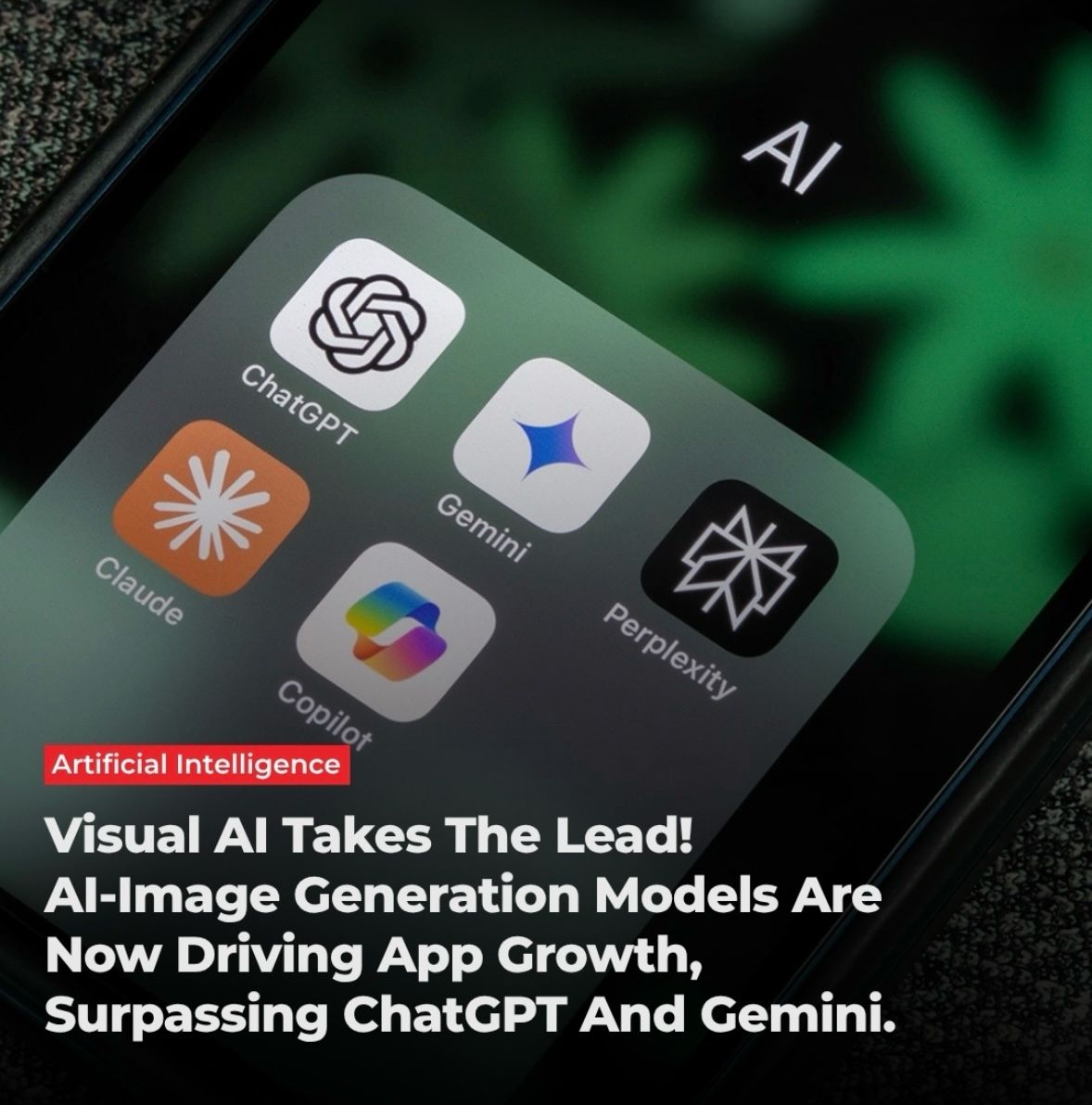

AI apps are no longer competing on intelligence alone.
They’re competing on visibility.
And image models just exposed that shift.
Because for the last two years, the AI race was mostly about reasoning:
- Better benchmarks
- Smarter outputs
- Longer context windows
- More capable chat interfaces
The assumption was simple that if the model becomes more intelligent, users will come.
But the mobile market is starting to show something different.
Visual AI features are now driving significantly more downloads than traditional chatbot upgrades.
And the numbers are hard to ignore.
According to Appfigures:
1. Gemini’s Nano Banana image rollout reportedly drove 22M+ additional downloads in 28 days
2. ChatGPT’s GPT-4o image launch added an estimated 12M+ installs
3. And image focused launches generated nearly 6.5x more downloads than traditional model upgrades
And that changes how consumer AI products spread.
📌 Visual outputs scale faster than invisible intelligence
Most reasoning improvements are difficult for average users to notice.
A slightly smarter chatbot rarely creates urgency but image generation creates immediate participation.
Which means every shared output becomes unpaid acquisition.
The product itself turns into distribution.
📌 Consumer AI is becoming behavior driven
Most AI companies still position themselves around better models, faster inference and larger context windows
But consumers adopt products based on identity, creativity, entertainment and social visibility
And visual AI compresses all four into a single interaction.
That’s why even companies with similar underlying models can see completely different growth outcomes depending on how socially visible their outputs become.
📌 But there’s also a second layer most startups will underestimate
Virality does not automatically create durable businesses.
Appfigures also showed that several viral AI launches generated huge download spikes without translating into meaningful revenue.
Which means attention is abundant,
but monetization still depends on retention and utility.
That’s why the companies that survive this phase probably won’t just build “fun AI.”
They’ll combine:
- Viral entry points
- Habit forming workflows
- And real product depth underneath the novelty
Because in AI, distribution can now happen instantly.
But trust still compounds slowly.
And if you want to understand how these patterns can actually make a difference in your business...we can break it down for you.
#VisualAI #MobileMarket #AppDownloads #AITrends #TechInnovation
They’re competing on visibility.
And image models just exposed that shift.
Because for the last two years, the AI race was mostly about reasoning:
- Better benchmarks
- Smarter outputs
- Longer context windows
- More capable chat interfaces
The assumption was simple that if the model becomes more intelligent, users will come.
But the mobile market is starting to show something different.
Visual AI features are now driving significantly more downloads than traditional chatbot upgrades.
And the numbers are hard to ignore.
According to Appfigures:
1. Gemini’s Nano Banana image rollout reportedly drove 22M+ additional downloads in 28 days
2. ChatGPT’s GPT-4o image launch added an estimated 12M+ installs
3. And image focused launches generated nearly 6.5x more downloads than traditional model upgrades
And that changes how consumer AI products spread.
📌 Visual outputs scale faster than invisible intelligence
Most reasoning improvements are difficult for average users to notice.
A slightly smarter chatbot rarely creates urgency but image generation creates immediate participation.
Which means every shared output becomes unpaid acquisition.
The product itself turns into distribution.
📌 Consumer AI is becoming behavior driven
Most AI companies still position themselves around better models, faster inference and larger context windows
But consumers adopt products based on identity, creativity, entertainment and social visibility
And visual AI compresses all four into a single interaction.
That’s why even companies with similar underlying models can see completely different growth outcomes depending on how socially visible their outputs become.
📌 But there’s also a second layer most startups will underestimate
Virality does not automatically create durable businesses.
Appfigures also showed that several viral AI launches generated huge download spikes without translating into meaningful revenue.
Which means attention is abundant,
but monetization still depends on retention and utility.
That’s why the companies that survive this phase probably won’t just build “fun AI.”
They’ll combine:
- Viral entry points
- Habit forming workflows
- And real product depth underneath the novelty
Because in AI, distribution can now happen instantly.
But trust still compounds slowly.
And if you want to understand how these patterns can actually make a difference in your business...we can break it down for you.
#VisualAI #MobileMarket #AppDownloads #AITrends #TechInnovation
Shared byRowan Yoon - 14 days ago
Log in to comment
Loading ..
Related Articles
Google Pay's Universal Commerce Protocol: AI Agents and Commerce Evolution
Balancing AI Agents and Automation in Real-World Workflows
Revolutionizing Sleep in India: The Rise of Adaptive Sleep Technology

AI's Surprising Role in Recovering Forgotten Bitcoin: A Man's $400,000 Recovery Story

Revolutionizing Fintech: How AI is Transforming Loan Approvals and Fraud Detection
Amazon's AI Hiring Bot: Mistake: The Dark Side of AI's Learning from Historical Data
37
0/100