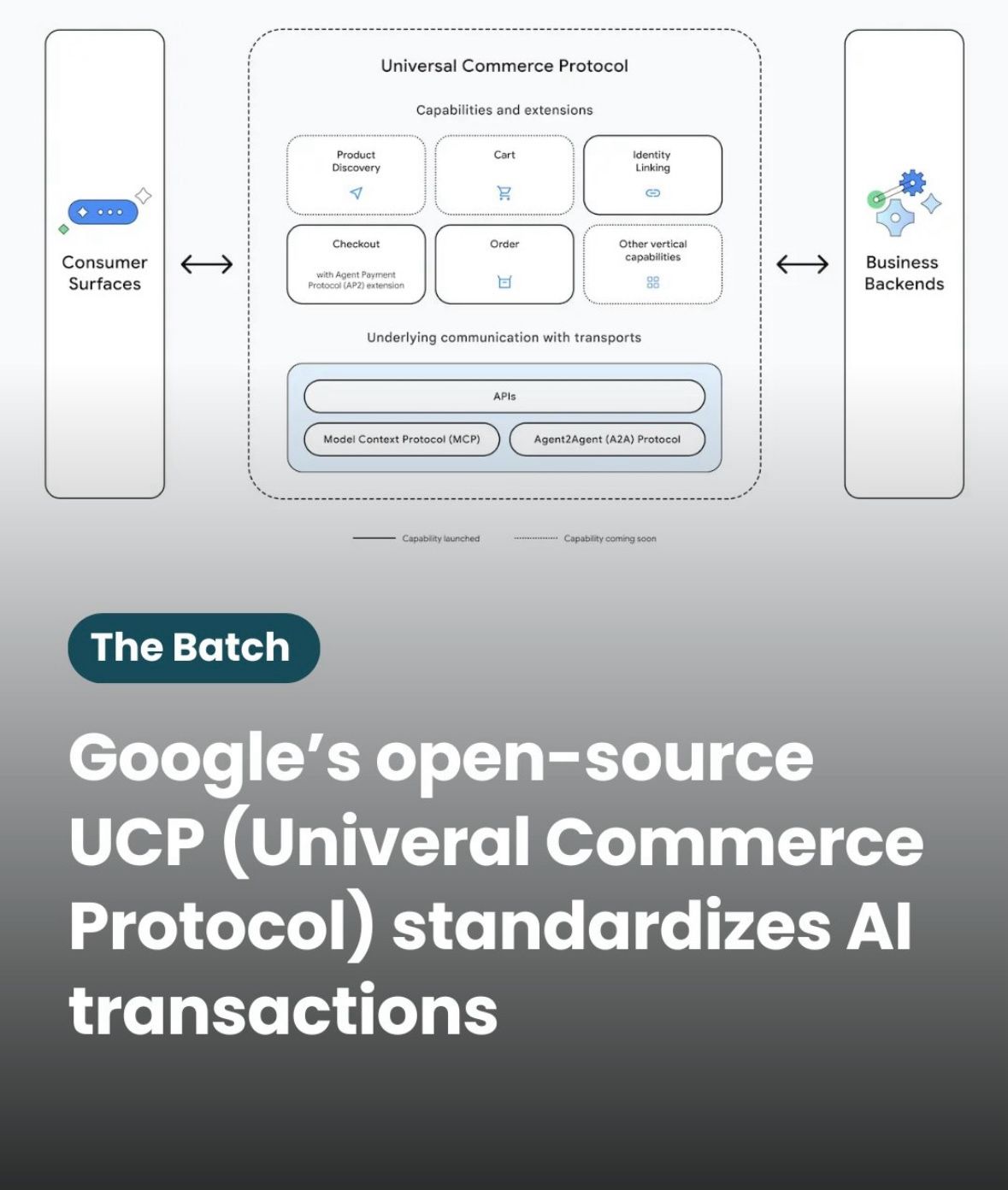

Google Pay is preparing for AI agents with something called the Universal Commerce Protocol.
And most people will scroll past this update but founders and businesses probably shouldn’t.
Because this isn’t just about payments.
It’s about preparing commerce for a world where AI agents start making purchasing decisions on behalf of humans.
And that changes how businesses compete online.
For years, companies optimized for human behavior:
Better ads
Better landing pages
Better conversion funnels
Everything was built to convince people to click.
But AI agents don’t behave like customers.
They care about:
1. Price accuracy
2. Delivery reliability
3. Refund history
4. Structured product data
5. System trust
And once agents start handling transactions, the advantage shifts quietly.
From presentation...
to operational quality.
That means businesses can’t rely only on branding, UI or attention anymore.
Because if backend systems are weak, agents will simply route transactions elsewhere.
And that creates a few important shifts:
📌 Infrastructure becomes a competitive advantage
Inventory accuracy, APIs, fulfillment speed and clean data stop being backend operations.
They become growth drivers.
📌 Trust becomes machine readable
Humans trust emotionally.
Agents trust statistically.
Cancellation rates, delivery consistency and refund reliability may become ranking signals in autonomous commerce.
📌 Distribution changes again
Today businesses compete for human attention.
Tomorrow they may compete for agent preference.
And those are completely different systems.
So the bigger lesson here is that AI is slowly moving competition away from, “who markets better”
Toward, “who operates better.”
The companies that win in the next phase of commerce may not be the loudest brands.
They may simply be the most machine compatible businesses.
#AI Commerce #Universal Protocol #AI Agents #Operational Quality #Future of Commerce
And most people will scroll past this update but founders and businesses probably shouldn’t.
Because this isn’t just about payments.
It’s about preparing commerce for a world where AI agents start making purchasing decisions on behalf of humans.
And that changes how businesses compete online.
For years, companies optimized for human behavior:
Better ads
Better landing pages
Better conversion funnels
Everything was built to convince people to click.
But AI agents don’t behave like customers.
They care about:
1. Price accuracy
2. Delivery reliability
3. Refund history
4. Structured product data
5. System trust
And once agents start handling transactions, the advantage shifts quietly.
From presentation...
to operational quality.
That means businesses can’t rely only on branding, UI or attention anymore.
Because if backend systems are weak, agents will simply route transactions elsewhere.
And that creates a few important shifts:
📌 Infrastructure becomes a competitive advantage
Inventory accuracy, APIs, fulfillment speed and clean data stop being backend operations.
They become growth drivers.
📌 Trust becomes machine readable
Humans trust emotionally.
Agents trust statistically.
Cancellation rates, delivery consistency and refund reliability may become ranking signals in autonomous commerce.
📌 Distribution changes again
Today businesses compete for human attention.
Tomorrow they may compete for agent preference.
And those are completely different systems.
So the bigger lesson here is that AI is slowly moving competition away from, “who markets better”
Toward, “who operates better.”
The companies that win in the next phase of commerce may not be the loudest brands.
They may simply be the most machine compatible businesses.
#AI Commerce #Universal Protocol #AI Agents #Operational Quality #Future of Commerce
Shared byParker Sato - A day ago
Log in to comment
Loading ..
Related Articles
Balancing AI Agents and Automation in Real-World Workflows
Revolutionizing Sleep in India: The Rise of Adaptive Sleep Technology
AI's Surprising Role in Recovering Forgotten Bitcoin: A Man's $400,000 Recovery Story
Revolutionizing Fintech: How AI is Transforming Loan Approvals and Fraud Detection
Visual AI's Impact on Mobile Market: Downloads vs. Traditional Chatbots
Amazon's AI Hiring Bot: Mistake: The Dark Side of AI's Learning from Historical Data
48
0/100