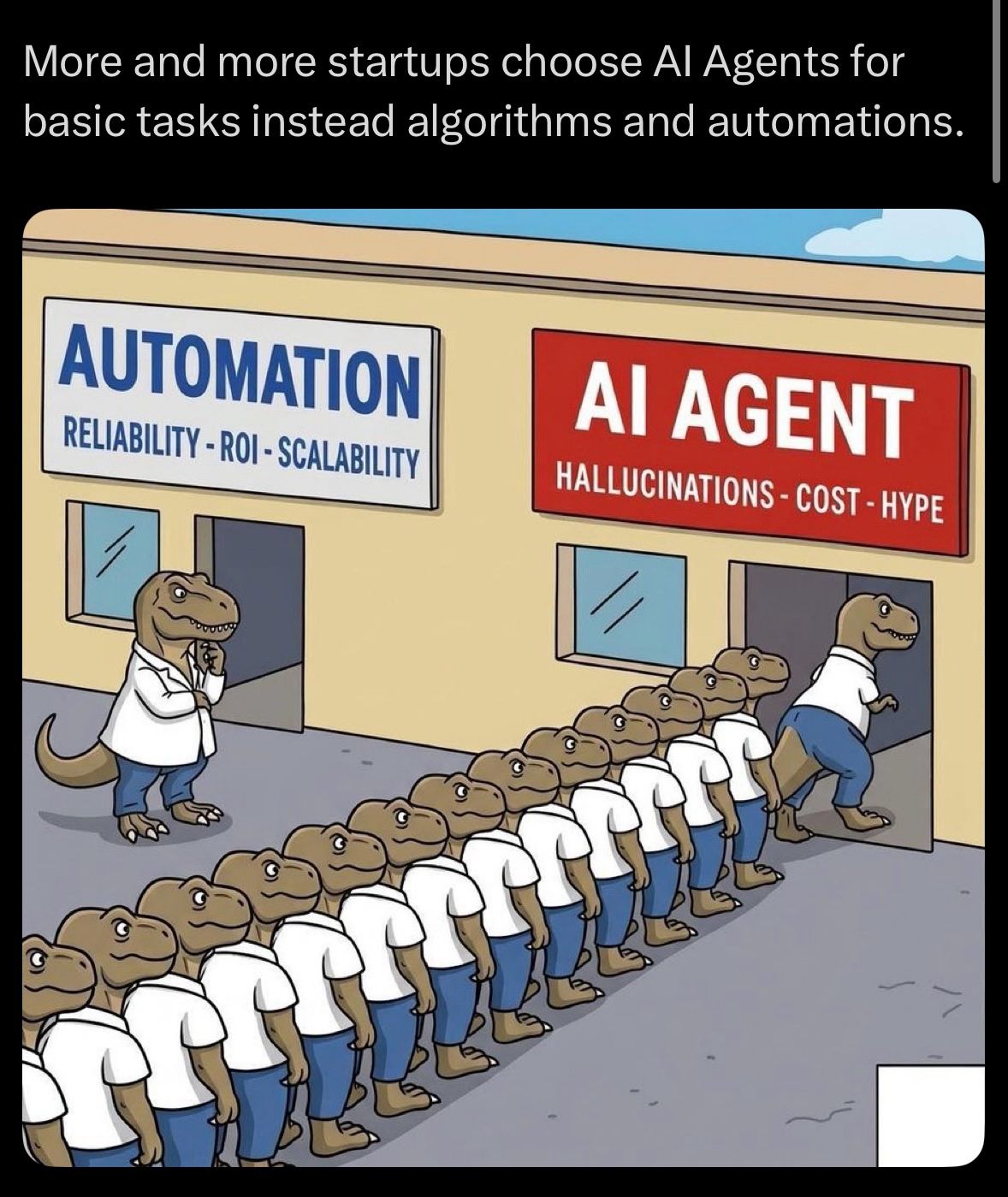

Most people look at AI agents and automation like a binary choice.
Automation = safe, deterministic
Agents = flexible, but risky (hallucinations, cost, hype)
But in real client systems at our AI & software development agency, that binary breaks immediately.
Because production workflows are never fully stable or fully dynamic.
They are mixed.
So the real work is not choosing AI agents or automation.
It’s deciding where each one belongs inside the system.
📌 We use automation when the process is stable
If the logic rarely changes, automation wins.
billing flows
API integrations
backend pipelines
structured internal workflows
Here, determinism is the product.
📌 We use AI agents when the environment is messy
When inputs are unstructured and constantly changing:
-client requirements in natural language
support tickets with ambiguity
document understanding
research + synthesis
decision support across incomplete data
Here, rigid rules fail faster than they scale.
But even then, agents are not free thinking systems.
📌 The real engineering layer is the boundary
The real question is not should we use agents?
It is what must stay deterministic, and what must stay adaptive?
That split decides reliability, cost, and scalability more than any model choice.
Automation handles structure.
Agents handle ambiguity.
And most failed AI systems come from mixing this without clarity.
The winners won’t be the ones using more AI.
They’ll be the ones who design the cleanest separation between logic and intelligence inside real workflows.
#AI & automation #workflow efficiency #AI agents #automation benefits #AI integration
Automation = safe, deterministic
Agents = flexible, but risky (hallucinations, cost, hype)
But in real client systems at our AI & software development agency, that binary breaks immediately.
Because production workflows are never fully stable or fully dynamic.
They are mixed.
So the real work is not choosing AI agents or automation.
It’s deciding where each one belongs inside the system.
📌 We use automation when the process is stable
If the logic rarely changes, automation wins.
billing flows
API integrations
backend pipelines
structured internal workflows
Here, determinism is the product.
📌 We use AI agents when the environment is messy
When inputs are unstructured and constantly changing:
-client requirements in natural language
support tickets with ambiguity
document understanding
research + synthesis
decision support across incomplete data
Here, rigid rules fail faster than they scale.
But even then, agents are not free thinking systems.
📌 The real engineering layer is the boundary
The real question is not should we use agents?
It is what must stay deterministic, and what must stay adaptive?
That split decides reliability, cost, and scalability more than any model choice.
Automation handles structure.
Agents handle ambiguity.
And most failed AI systems come from mixing this without clarity.
The winners won’t be the ones using more AI.
They’ll be the ones who design the cleanest separation between logic and intelligence inside real workflows.
#AI & automation #workflow efficiency #AI agents #automation benefits #AI integration
Shared byLogan Bose - 14 hours ago
Log in to comment
Loading ..
Related Articles
Google Pay's Universal Commerce Protocol: AI Agents and Commerce Evolution
Revolutionizing Sleep in India: The Rise of Adaptive Sleep Technology

AI's Surprising Role in Recovering Forgotten Bitcoin: A Man's $400,000 Recovery Story

Revolutionizing Fintech: How AI is Transforming Loan Approvals and Fraud Detection

Visual AI's Impact on Mobile Market: Downloads vs. Traditional Chatbots
Amazon's AI Hiring Bot: Mistake: The Dark Side of AI's Learning from Historical Data
170
0/100