
Last month, we tested the same AI agent across 3 different workflows and it gave us 3 completely different outcomes.
1. One worked reliably
2. One was inconsistent
3. One failed silently
Nothing changed... except the design.
That’s when it became obvious that agent performance doesn’t come from the model.
It comes from the pattern behind it.
Because most teams are still thinking in terms of:
“Let’s plug an LLM into a workflow.”
But agentic systems don’t behave like software features.
They behave like decision loops.
And small changes in those loops create massive differences in outcomes.
That’s why the teams actually getting value from agents in 2026 are using a few design patterns most people overlook:
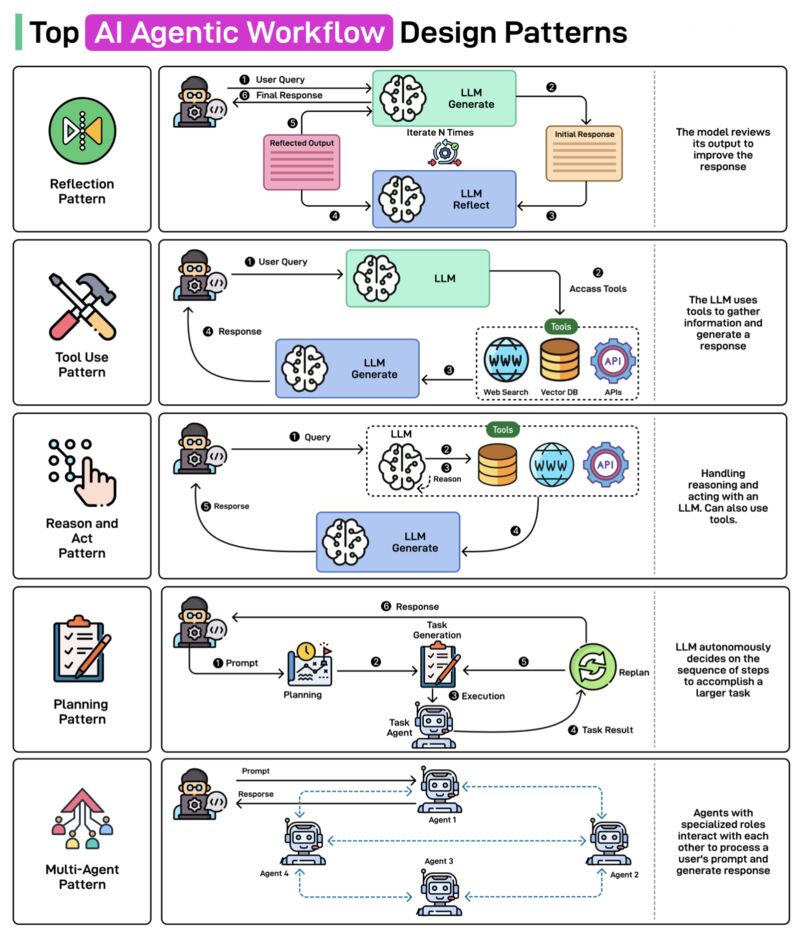
📌 Reflection Pattern:
Most agents generate once and move on.
Better systems don’t.
They force a loop:
Generate → Critique → Improve
That second pass catches reasoning gaps, hallucinations and weak outputs before they propagate.
You’re not upgrading the model but you’re upgrading the reliability with this one.
📌 Tool Use Pattern:
Agents shouldn’t try to know everything but they should know when to call:
APIs
Databases
Search
External tools
Because real workflows aren’t solved by memory, they’re solved by interaction.
This pattern is what connects intelligence to execution.
📌 Reason + Act Pattern (ReAct):
Instead of one shot outputs, the agent works in cycles:
Reason → Act → Observe → Reason again
Each step updates the next.
So the system adapts in real time instead of committing to a single path.
📌 Planning Pattern:
Most agents fail because they jump straight into execution.
Planning forces structure:
Break the task → sequence it → execute step by step
This is what makes agents usable for complex operations, multi step workflows and long running processes
Without planning, outputs feel random.
With planning, they become predictable.
📌 Multi-Agent Pattern:
One agent doing everything looks efficient.
Until it becomes a bottleneck.
Instead, split roles:
One agent researches
One reasons
One executes
One validates
Now you don’t have a single point of failure.
You have a system that can scale.
And that’s where the real advantage lives.
And if you want to understand how these patterns can actually make a difference in your business...we can break it down for your workflows and show exactly where the leverage is.
#AIagentdesign #workflowoptimization #decisionloops #ReActpattern #multiagentsystems
1. One worked reliably
2. One was inconsistent
3. One failed silently
Nothing changed... except the design.
That’s when it became obvious that agent performance doesn’t come from the model.
It comes from the pattern behind it.
Because most teams are still thinking in terms of:
“Let’s plug an LLM into a workflow.”
But agentic systems don’t behave like software features.
They behave like decision loops.
And small changes in those loops create massive differences in outcomes.
That’s why the teams actually getting value from agents in 2026 are using a few design patterns most people overlook:
📌 Reflection Pattern:
Most agents generate once and move on.
Better systems don’t.
They force a loop:
Generate → Critique → Improve
That second pass catches reasoning gaps, hallucinations and weak outputs before they propagate.
You’re not upgrading the model but you’re upgrading the reliability with this one.
📌 Tool Use Pattern:
Agents shouldn’t try to know everything but they should know when to call:
APIs
Databases
Search
External tools
Because real workflows aren’t solved by memory, they’re solved by interaction.
This pattern is what connects intelligence to execution.
📌 Reason + Act Pattern (ReAct):
Instead of one shot outputs, the agent works in cycles:
Reason → Act → Observe → Reason again
Each step updates the next.
So the system adapts in real time instead of committing to a single path.
📌 Planning Pattern:
Most agents fail because they jump straight into execution.
Planning forces structure:
Break the task → sequence it → execute step by step
This is what makes agents usable for complex operations, multi step workflows and long running processes
Without planning, outputs feel random.
With planning, they become predictable.
📌 Multi-Agent Pattern:
One agent doing everything looks efficient.
Until it becomes a bottleneck.
Instead, split roles:
One agent researches
One reasons
One executes
One validates
Now you don’t have a single point of failure.
You have a system that can scale.
And that’s where the real advantage lives.
And if you want to understand how these patterns can actually make a difference in your business...we can break it down for your workflows and show exactly where the leverage is.
#AIagentdesign #workflowoptimization #decisionloops #ReActpattern #multiagentsystems
Shared byFinley Cole - 21 days ago
Log in to comment
Loading ..
Related Articles
Google Pay's Universal Commerce Protocol: AI Agents and Commerce Evolution
Balancing AI Agents and Automation in Real-World Workflows
Revolutionizing Sleep in India: The Rise of Adaptive Sleep Technology

AI's Surprising Role in Recovering Forgotten Bitcoin: A Man's $400,000 Recovery Story

Revolutionizing Fintech: How AI is Transforming Loan Approvals and Fraud Detection

Visual AI's Impact on Mobile Market: Downloads vs. Traditional Chatbots
60
0/100